 The effectiveness of a drilling fluid in performing its several functions is directly related to density, viscosity, gel strength, and filtration. These properties are associated with the colloidal or clay fraction of the fluid, which can be altered by treatment. The two problems in mud control are:
• Determining what adjustments need to be made.
• Selecting the processes and materials by which those needs can be satisfied.
Drilling fluid treatment requires an understanding of certain basic procedures. To “mud up”, or to add bentonite to a freshwater drilling fluid, increases viscosity and gel strength and lessens water loss. Such an addition of solid materials is normally made to clear water fluids having less than 6,000 ppm of the chloride ion and 1,000 ppm of the calcium ion.
Where salt contamination may be a problem, premium clays are used. Salt clays are used to mud up salty clays; these materials increase viscosity but do not affect filtration.
Carboxymethyl cellulose, or CMC as normally called, will improve filtration for fluid in which salt contamination ranges up to 20,000 ppm of chloride. Starch and polyanionic cellulose, PAC as normally called, can be used to reduce water loss in fluids with almost any level of salt contamination.
 Sometimes a sedimentary basin is uplifted so that deposition ceases and erosion takes over. An erosion surface is formed; the upper surface of the most recent sediment layer, formerly smooth and horizontal, is modified by running water or other agents.
Later, the region subsides and more sediment accumulates. If the succession of sedimentary layers is thought of as a chronological record, then the buried erosion surface represents a time gap of indeterminate length. Such a gap is called an unconformity.
There are several kinds of unconformity. If the uplift is gentle, so that the rock layers are not tilted or deformed, the gap in the geologic record is termed as disconformities. Although the layers of sediment above are parallel with those below, the shapes of ancient stream channels are often apparent in disconformities. However, the disconformities itself may be parallel with the layers above and below and therefore not readily apparent.
Deposition of sediments on layers that have been deformed and eroded produces an angular unconformity. Sedimentary layers below such nonconformity are not parallel with those above, and the gap in the record is obvious.
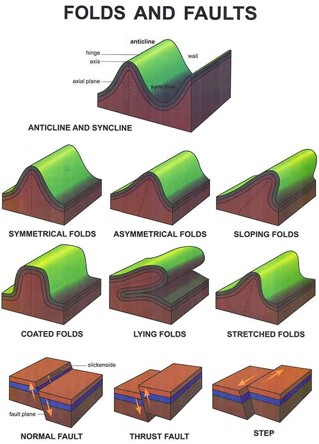 Tectonic plate motion is one of the events that can change the shape and orientation of sedimentary rock layers. Wherever plates converge, the crust is subjected to enormous horizontal forces that can gradually compress it by dozens or even hundreds of miles, wrinkling and folding it like a giant throw rug. The up fold of the crust is an anticline; each down fold is a syncline.
Anticlines and synclines are graphic proof that solid rock can flow like the ice in a glacier. Like most solid materials, rock is slightly plastic under uniform pressure over long periods, it will bend without breaking. However, if stress is applied unevenly or if it exceeds the rock's breaking strength, the rock fractures. A fracture in the crust along which the rocks on opposite sides have shifted relative to each other is termed a fault.
A normal fault is one whose slip plane is at a steep angle with the surface and along which the rock on the upper side has slipped downward in the direction of the dip. In geology, the dip of any surface is the direction in which a marble would roll if placed on it.
A reverse or thrust, fault is one in which the rock on the upper side has been displaced upward along the fault plane. A normal fault allows extension of the crust; it is often caused by forces that stretch the crust. A thrust fault is caused by forces that squeeze the crust together, causing a break where one piece overrides another.
An over-thrust fault is a thrust fault whose slip plane is nearly horizontal its displacement is the result of large horizontal movements of the crust. Along some over-thrust faults, one slab has slipped several miles over the top of another so that a well drilled through the fault would penetrate the same series of rock layers twice.
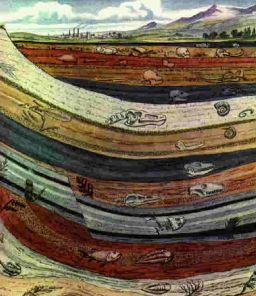 As geologists gather information about the structure and character of the rock formations, they arrange it in graphic form. This not only helps them visualize what they cannot see directly, but also provides a way to communicate their findings to others. In particular, it helps them visualize and display the stratigraphy of the crust-information that describes the origin, composition, distribution, and succession of rock layers.
Maps, Sections, and Diagrams
Geologic information can be arranged graphically to show variation either horizontally or vertically. Horizontally arrayed data are maps; vertically arrayed data are sections. Sometimes these two types of arrays are combined in a simulated three-dimensional graph.
A geologist usually starts with a base map of the area of interest, showing survey benchmarks, property lines, and such non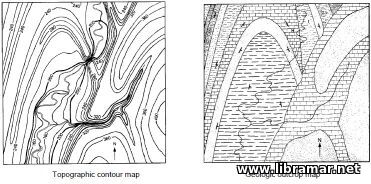 geologic surface features as streams, roads, and buildings. Base maps are useful for planning exploration, leasing, road building, well placement, and other activities. geologic surface features as streams, roads, and buildings. Base maps are useful for planning exploration, leasing, road building, well placement, and other activities.
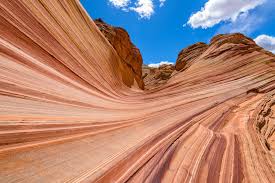 Each depositional environment has its characteristic assemblage of sedimentary rock types. When discussing these types, it is convenient to think in terms of three basic types: clastics, carbonates, and evaporates. Note, however, that any rock is likely to have characteristics of more than one of these types.
Clastics
Clastic sedimentary rocks are composed mostly of particles derived from other rocks. There are two basic types of clastic particles: mineral grains, composed entirely of a single mineral, such as quartz, feldspar, or mica; and lithic grains, which consist of an assemblage of different minerals, like miniature rocks. In rocks with clastic texture, the grains touch each other but do not interlock. The crystalline texture of igneous rock, by contrast, is characterized by mineral grains that are in contact on all surfaces, having formed and grown together as the rock solidified. Sedimentary rock usually has empty (or fluid-filled) spaces between grains.
Clastic rocks are classified primarily by grain size. They are named according to the size of the particles that make up more than 50 percent of their bulk. A rock composed of 60 percent sand and 40 percent calcite, for example, would be called limy sandstone.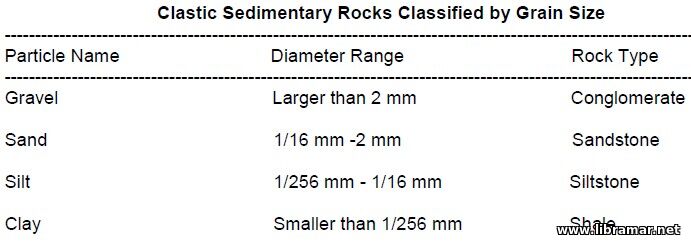
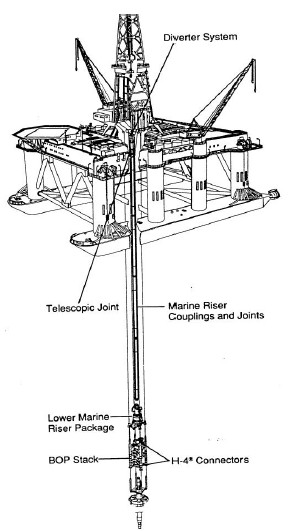 Semi-submersible rigs have the advantage of being able to move away from a location very quickly, as opposed to a jack up rig. This is a good thing in arctic areas if an iceberg comes rambling down, at 10 miles per hour, strait on collision course with the rig. Semi-submersible rigs are used for exploration, development and sometimes also for production work in deep waters.
Large semi-submersible rigs can be quite self-contained and can operate for long periods without re-supply. They are more like ships in behavior and require additional equipment to control stability in order to function properly.
This equipment includes ballast management systems, motion compensators for keeping the drill string on bottom and a riser pipe that isolates the well from the open sea between sea floor and rig. The riser is a set of large pipes which is locked together with seals and bolts in a special way to ensure flexibility and pressure integrity. The riser may have flotation elements attached on the outside to balance the weight of the riser in the water and minimize weight support from rig as this will limit the rigs load capacity.
The Well control equipment (BOP) used on a semi-submersible rig are normally attached to the top of the wellhead at the seafloor. This equipment is remote controlled from the rig through an umbilical or hoses. The main reason for placing the BOP on the sea floor is to prevent high pressure well conditions to enter the riser. As the riser has to be large enough to allow drill string, bit and various casing sizes to pass through, it also has to be strong enough to withstand high well bore pressures. Most risers can hold up to 5000 psi pressure.
There are drilling setups where BOP‘s are located at surface, but then the riser has to have the same pressure rating as the BOP. If the BOP‘s were located at surface, it would be impossible to disconnect at the sea floor as the well would then be open to the environment.tensioner.
 For the petroleum geologist, sedimentary rock is the most interesting type of rock. Some sedimentary rock formations are porous enough to hold great quantities of oil and gas; others contain high proportions of the organic matter from which, under certain conditions, hydrocarbons are generated.
Sedimentary rock is rock made up of fragments or chemical compounds from previously existing rocks or organisms. Carried by flowing water, ice, or air in response to the force of gravity, sediment accumulates in upland basins and along the edges of the continents. The depth of an accumulation can reach several miles. Deeply buried sediments are transformed into hardened rock by a set of processes called, collectively, lithification. The processes that alter the rock itself, either during or after its formation, are called diagenesis.
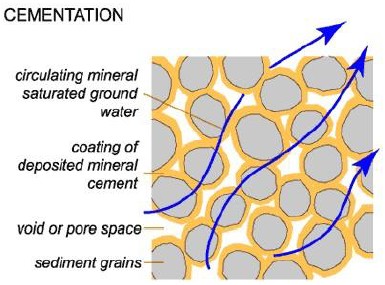
Compaction and cementation are two of the principal processes that change sediments into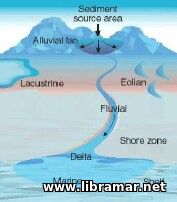 rock. As successive layers of water-saturated sediment accumulate, the deeper layers are compacted by the weight of overlying beds. The individual grains are forced into closer contact and, in some cases, are deformed. Minerals dissolved in the water-commonly, calcite form a solid material that cements the grains together. Much of the water is squeezed out as the sediment is transformed into rock, but some becomes trapped in the pores as connate, or interstitial, water. Rock formed from sediments deposited by water almost always contains interstitial water. rock. As successive layers of water-saturated sediment accumulate, the deeper layers are compacted by the weight of overlying beds. The individual grains are forced into closer contact and, in some cases, are deformed. Minerals dissolved in the water-commonly, calcite form a solid material that cements the grains together. Much of the water is squeezed out as the sediment is transformed into rock, but some becomes trapped in the pores as connate, or interstitial, water. Rock formed from sediments deposited by water almost always contains interstitial water.
Close study of sedimentary rock reveals the conditions under which it was formed. One set of conditions includes the events that occur beneath the surface during lithification and diagenesis compaction, cementation, and chemical alteration by groundwater. The natural conditions that most influence the character of sedimentary rock are, however, those that occur at the earth's surface, where the solid earth is in contact with the fluids of the atmosphere and the oceans and where plants and animals live. The set of physical, chemical, biological, and geologic conditions under which the original sediments of a given rock layer were laid down are called the depositional environment.
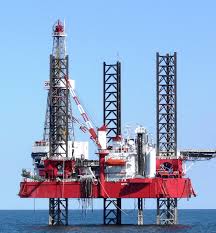 Jack-up drilling rigs are built as drilling platforms with jack-able legs. The platform will float when the legs are retracted and can thus be moved around the world on water. The jack-up rig is one of the most versatile rig designs available. The largest jack-up type rigs can work in water depths up to 150 meter and can also work in very shallow water depths. Among the many advantages of the jack-up rig is the fact that as soon as it is jacked up and into drilling position, it is a very stable platform and does not need motion compensation of any sort as required by a floating rig type.
Most jack-up designs today consist of a triangular hull with one leg in each corner. The hull is several floors high (thick) and contains most of the “indoor” equipment required to make the rig work. Indoor equipment includes generator sets, mud pumps, mud mixing and cleaning systems, bulk stores, mud tanks, water and fuel tanks as well as all the systems required for a hotel with accommodation for at least 100 people.
Attached to the top of the hull is first and foremost the living quarters and offices; on relatively old oil rigs, these can still be located below deck level, but this is not allowed anymore). Also on the topside is the drilling package itself, often contained on a cantilevered skid which enables the drilling package to center itself over different slots or wells. The rig is often used to drill production wells from templates or jackets with many well slots and for this reason is required to be able to crisscross over a grid of well heads.
The drilling package is located between two of the corners and positioned in such a way that the drilling package is stable and has maximum load bearing capability. a way that the drilling package is stable and has maximum load bearing capability.
The legs on a jack-up rig are special. They not only have to withstand and be able to lift the entire weight of the rig, the legs also have to resist twisting forces and high wind loads as well.
Modern Jack-up legs are often triangular in shape and have something called a spud can mounted on bottom of each leg. The spud can is a large dome shaped tank and is working as the foot of the leg absorbing weight of the rig and due to its large area prevents high leg penetration into the seabed.
|