Unconformity

Sometimes a sedimentary basin is uplifted so that deposition ceases and erosion takes over. An erosion surface is formed; the upper surface of the most recent sediment layer, formerly smooth and horizontal, is modified by running water or other agents.
Later, the region subsides and more sediment accumulates. If the succession of sedimentary layers is thought of as a chronological record, then the buried erosion surface represents a time gap of indeterminate length. Such a gap is called an unconformity.
There are several kinds of unconformity. If the uplift is gentle, so that the rock layers are not tilted or deformed, the gap in the geologic record is termed as disconformities. Although the layers of sediment above are parallel with those below, the shapes of ancient stream channels are often apparent in disconformities. However, the disconformities itself may be parallel with the layers above and below and therefore not readily apparent.
Deposition of sediments on layers that have been deformed and eroded produces an angular unconformity. Sedimentary layers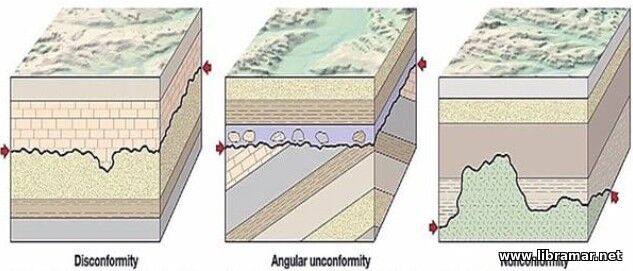 below such nonconformity are not parallel with those above, and the gap in the record is obvious.
The most profound gap in the depositional record is the one beneath the oldest sedimentary layers. Nonconformity is an erosion surface on igneous or metamorphic rock that has been buried beneath sediments. In the geology of petroleum exploration, the rock beneath nonconformity is usually referred to as basement rock.
Any unconformity is obviously younger than the rocks beneath it and older than those above. It is thus a useful tool in determining the relative ages of rocks and the events that have affected them over geologic time.


The "Read Later" function allows you to add material to this block with just one click. Just click on the icon and read the articles that interest you at any convenient time.