Folding and Faulting
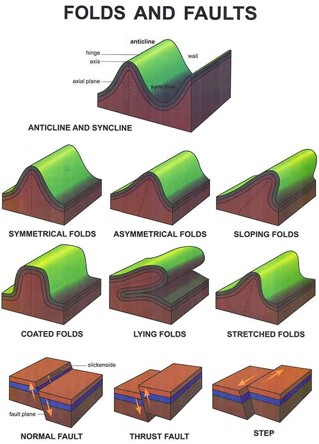
Tectonic plate motion is one of the events that can change the shape and orientation of sedimentary rock layers. Wherever plates converge, the crust is subjected to enormous horizontal forces that can gradually compress it by dozens or even hundreds of miles, wrinkling and folding it like a giant throw rug. The up fold of the crust is an anticline; each down fold is a syncline.
Anticlines and synclines are graphic proof that solid rock can flow like the ice in a glacier. Like most solid materials, rock is slightly plastic under uniform pressure over long periods, it will bend without breaking. However, if stress is applied unevenly or if it exceeds the rock's breaking strength, the rock fractures. A fracture in the crust along which the rocks on opposite sides have shifted relative to each other is termed a fault.
A normal fault is one whose slip plane is at a steep angle with the surface and along which the rock on the upper side has slipped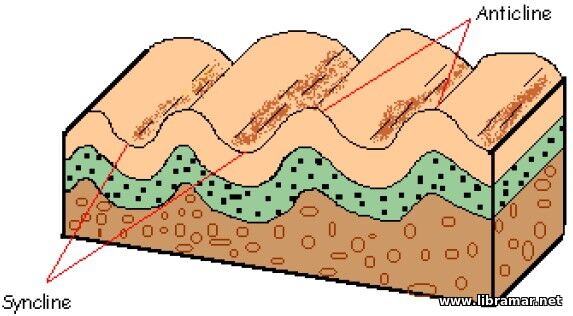 downward in the direction of the dip. In geology, the dip of any surface is the direction in which a marble would roll if placed on it.
A reverse or thrust, fault is one in which the rock on the upper side has been displaced upward along the fault plane. A normal fault allows extension of the crust; it is often caused by forces that stretch the crust. A thrust fault is caused by forces that squeeze the crust together, causing a break where one piece overrides another.
An over-thrust fault is a thrust fault whose slip plane is nearly horizontal its displacement is the result of large horizontal movements of the crust. Along some over-thrust faults, one slab has slipped several miles over the top of another so that a well drilled through the fault would penetrate the same series of rock layers twice.
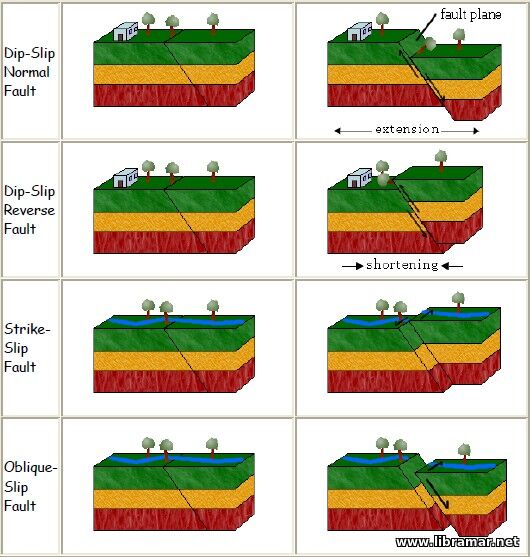 The opposite sides of a lateral, or strike-slip, fault move horizontally past each other; the fault plane itself may be vertical. The most familiar example is California's San Andreas fault, where the Pacific plate is slipping northward about 2 inches per year past the edge of the North American plate. If this slip occurred continuously, the San Andreas fault would be merely a geologic curiosity. Instead, sections of the fault "lock up" for years, releasing the strain all at once in a sudden, powerful earthquake.
One type of fault common along the Gulf Coast is the growth, or rollover, fault. Often invisible at the surface, a growth fault is an active slip plane in unconsolidated sediments where continued deposition causes layers on the downthrown side to grow thicker than those across the fault. The plane of a growth fault curves toward the horizontal at depth, and total displacement at depth is greater than near the surface. Curvature of the layers on the downthrown side often creates a broad rollover anticline.


The "Read Later" function allows you to add material to this block with just one click. Just click on the icon and read the articles that interest you at any convenient time.