Basic Drilling Fluid Properties
The effectiveness of a drilling fluid in performing its several functions is directly related to density, viscosity, gel strength, and filtration. These properties are associated with the colloidal or clay fraction of the fluid, which can be altered by treatment. The two problems in mud control are:
• Determining what adjustments need to be made.
• Selecting the processes and materials by which those needs can be satisfied.
Drilling fluid treatment requires an understanding of certain basic procedures. To “mud up”, or to add bentonite to a freshwater drilling fluid, increases viscosity and gel strength and lessens water loss. Such an addition of solid materials is normally made to clear water fluids having less than 6,000 ppm of the chloride ion and 1,000 ppm of the calcium ion.
Where salt contamination may be a problem, premium clays are used. Salt clays are used to mud up salty clays; these materials increase viscosity but do not affect filtration.
Carboxymethyl cellulose, or CMC as normally called, will improve filtration for fluid in which salt contamination ranges up to 20,000 ppm of chloride. Starch and polyanionic cellulose, PAC as normally called, can be used to reduce water loss in fluids with almost any level of salt contamination.
However, starch, unlike CMC or PAC, tends to ferment in certain fluids requiring the addition of preservatives such as paraformaldehyde or chlorinated phenol. In fluids with a pH over 11.5 and in fluids with a salt content over 150,000 ppm chloride, starch fermentation is not a problem.
To weight up, that is, to add barite or some other heavy mineral, increases drilling fluid density. This procedure controls formation fluid pressure and, in some cases, affords better support to wellbore walls, decreasing the likelihood of problems with sloughing shale. To thin a drilling fluid means to disperse or de-flocculate mud solids. This process can improve the clay fraction of an uncontaminated fluid and the amount of water loss. Polyphosphates and lignosulfonates are among the chemicals used for thinning. Some lignosulfonates, as well as one particular sulfomethylated tannin compound, can even thin contaminated drilling fluids.
To water-back a fluid refers to the process of dilution, or altering the water-to-solids ratio by adding water. When a chemically treated fluid requires dilution, it is often because solids have accumulated in the course of drilling.
To emulsify a clay-water drilling fluid is to disperse oil into an existing day-water medium. Emulsifying often improves lubricating properties, lowers water loss, and decreases the chances of a bit's balling up. Under such improved conditions, lower pump pressures may be used and faster shale-drilling rates can be achieved.
Using these procedures, the properties of most drilling fluids can be adjusted to overcome most drilling problems such as abnormal pressure, lost circulation, and sloughing shale.
The selection of the proper drilling fluid additive for certain conditions is sometimes confusing, however, because of the large number of mud dealers and the wide variety of trade names. To simplify this problem, it is convenient to think of mud additives in terms of their particular applications, as follows:
• Barite weighting materials are used to weight up drilling fluids to levels over 10 ppg.
• Bentonite and premium clays are used to improve viscosity, suspension, and wallbuilding properties.
• Thinners or deflocculating agents are primarily used for viscosity and gel strength control. They are also used to control water loss and enhance the formation of emulsions.
• Filtration control agents are used for reducing water loss.
• Lost circulation materials are used to prevent or remedy circulation losses.
• A variety of special products control other mud properties such as emulsification, lubrication, foaming, fermentation, and corrosion inhibition.
Density
One of the major functions of drilling fluid is to keep all formation fluids - oil, gas, and water-in their places. Any flow of formation fluids into the well must be prevented or at least controlled. The hydrostatic pressure of the fluid column must be sufficient to prevent such formation fluid entry, or a kick, from occurring. This pressure is determined, for the most part, by density of the drilling fluid.
A drilling fluid that is too heavy can cause circulation losses to the formation, and the balance between full circulation and circulation loss is often very close. For example, a 0.1-0.2 ppg difference in drilling fluid density can mean the difference between confining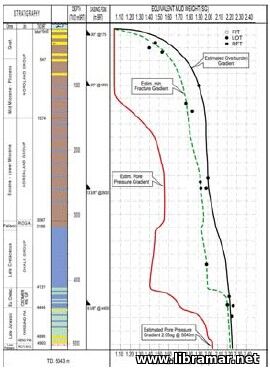 formation fluids adequately or breaking down the formation.
Regardless of the density required, the density of the drilling fluid, along with the pit level and salt content, should be checked at regular intervals to make sure that a stable, sufficient drilling fluid density is being maintained, both to prevent formation fluid entry and to support the formation where casing has not been set. A sudden drop in density, a rise in pit level, or a rise in salt content may indicate an unwanted flow.
Showings of trip gas (gas that enters the well during a trip), or increases in salt content after a trip could indicate swabbing (a loss of hydrostatic pressure accompanying withdrawal of drill pipe). Checking also helps prevent unnecessary rises in density that result in circulation loss.
Barite, or barium sulfate is accepted as the standard material for weighting mud. It is commercially available at specific gravities from 4.20 to 4.35, a weight several times that of an equal volume of water. Barite does not hydrate when wet; it remains in the inert fraction of a drilling fluid. Barite alone may comprise one-half to two-thirds of total drilling fluid costs for drilling in areas where abnormal downhole pressures are encountered.
Where pressures are normal, barite costs are generally closer to 5 percent of the mud material bill. Table below provides a convenient way to find the number of 100 lb sacks of barite required to increase the drilling fluid density.
The common earth minerals - clays, shale, sand, and limestone have specific gravities of about 2.6, and because of clay yield, clay and shale drilling fluids can rarely be made to weigh much more than 10 ppg. In general, the problem with low-weight drilling fluid is to keep the weight down, generally accomplished by constant additions of water. Sand accumulations at shallow depths increase fluid density and cause the breakdown of formations. This weight increase can usually be remedied by adding water. Water, chemical thinners, and mechanical devices like desanders and desilters keep sand and silt content down after the surface casing cement has been drilled out.
Any alteration of drilling fluid density should be attended to very carefully. Whether the density is to be increased or decreased, additives should be mixed slowly and evenly into the fluid to avoid forming light or heavy slugs in the drilling fluid system. The time required for the fluid to make a complete cycle is also important. Often, one or two cycles are necessary for a complete treatment with barite or some other chemical additive.
For optimum thinning, weighted drilling fluids are usually chemically treated. When the chemicals no longer work, water can be added to the system below the shale shaker, reducing solids content to maintain a workable viscosity and restoring any water lost in filtration or evaporation. The table above demonstrates how the addition of water can reduce density. For density over 12 ppg, a separator is often the most economical way to separate drill solids from the mud and return barite to the system.
 The addition of barite also increases the volume of the circulating system by approximately 7 barrels per 100 sacks. Such a volume increase should be considered before barite is added so that the excess fluid can be pumped to the reserve pit.
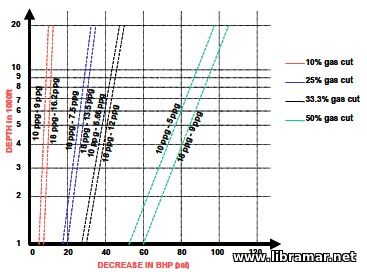
Gas cutting, or the entry of formation gas into the drilling fluid, can lower density, requiring the addition of barite or another additive to prevent a blowout. In drilling with a small overbalance, that is, when the pressure of the mud column is only slightly greater than formation pressure, mud flow properties must be maintained with water and chemicals to permit the escape of trip gas or other minor intrusions. A degasser can also be helpful in removing gas from the mud.
Viscosity and Gel Strength
A drilling fluid's viscosity is its resistance to flow. Viscosity can be measured with a Marsh Funnel, which measures the rate of flow, or a rotational viscometer. In general, these two measurement devices give similar results, but there is no way of converting the measurements of one device into reliable values for the other.
The multispeed rotational viscometer has become widely accepted for assessing mud properties because it separates viscosity measurement into two categories: plastic viscosity and yield point. In terms of rheology, which is the study of flow properties of liquids and gases, plastic viscosity depends primarily on the solids in the mud system and the viscosity of the liquid phase. Yield point, on the other hand, is determined by the attractive forces between the clay particles and, to a lesser extent, by friction between those particles. Changes in plastic viscosity cause slight changes in yield point, but yield point may be altered with little or no change in plastic viscosity. The addition of water decreases plastic viscosity; yield point is lowered with chemical thinners. In regard to absolute flow, plastic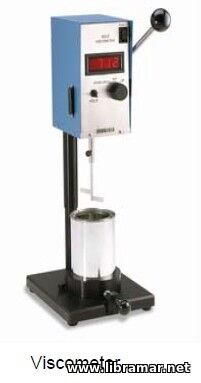 viscosity and yield point reflect the colloidal and surface-active properties of mud solids.
Gel strength, the measure of a mud's capacity to hold solids in suspension, is closely associated with viscosity. While viscosity measurement requires a viscometer or a Marsh funnel, gel strength can be determined by observing the way the mud flows and stiffens in the ditches and pits. This tendency of drilling fluid to gel when stationary is greater in some fluids than in others. A fluid that sets too solidly may require high pump pressure to restore flow or break circulation after the fluid has been in the hole only a short time.
Viscosity, yield point, and gel strength should be kept low enough to allow shale cuttings, sand, and entrained gas to settle out or escape. Low viscosity allows for adequate circulation at low pump pressure and minimizes the swabbing that may occur when pipe is pulled from the hole. High viscosity, yield point, and gel strength are undesirable qualities in a mud, but they can be corrected if the causes are known.
For example, insufficient de-flocculation of clay solids can be remedied by chemical thinning. High concentrations of solids can be reduced by dilution or mechanical separation. When high viscosity is the result of salt, cement, or anhydrite contamination, thinners or filtration control agents may be effective remedies.
The following rules of thumb for viscosity are suggested as being typical of good drilling fluids:
• Funnel viscosity for un-weighted drilling fluids ranges between 28 and 40 seconds.
• Where weight material is being added, funnel viscosity ranges between 40 and 50 seconds.
• Funnel viscosity over 50 seconds usually indicates high-weight drilling fluid or low annular velocity. Oil-emulsion drilling fluid with high viscosity (75-120 seconds) and low gel strength are used to drill difficult shale sections in some areas.
Filtration
Water is continually lost from drilling fluid to permeable formations during drilling operations.
A permeable formation such as sand operates as a strainer, holding back the solids in the drilling fluid while permitting the water to pass into pore spaces. These solids are deposited on the face of the sand in the form of a coating, or filter cake. No cake is formed on impermeable shale, but its surface is wetted by the water of the drilling fluid. Although the reason for this wetting is not well understood, it does take place and may cause sloughing and caving.
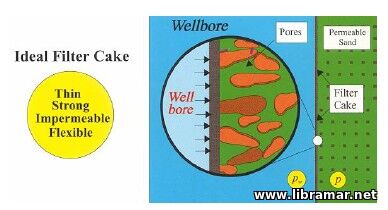 Excessive water loss has several undesirable effects. Filter cake buildup can cause tight places in the hole and drill string sticking. Shale sloughing and caving can occur. The amount of wetting of shale surfaces in the hole and along joints and fractures is apparently related to the water loss of the mud. Excessive water loss to porous formations hampers the interpretation of electric logs. Water entry into pay zones can complicate well completion.
The amount of water loss can usually be lowered by the addition of chemical thinners or other additives such as bentonite, pregelatinized starch, CMC, PAC, polyacrylates, gums, and emulsified oil. However, the common contaminants-salt, cement, and anhydrite cause flocculation of clays to the extent that these particular additives are no longer effective in controlling filtration, and one or more of the other filtration control agents must be used.
pH Factor
Most drilling fluids are alkaline, having a pH between 8 and 13. Table below lists some commonly used drilling fluids and the pH range in which they are usually controlled. The organic dispersants such as quebracho, lignite, and lignosulfonates are grouped together.
The choice of dispersant is determined to some extent by the pH range desired and the type of mud used. The pH of double-distilled water and of barite is approximately 7.0, which is neutral, neither acidic nor alkaline. The bentonite and most good drilling clays have a pH of 8.0 or slightly higher.
In drilling fluid treating it is useful to disregard the many trade names and consider the chemical best suited for the drilling situation. The chemicals that have been found most effective as viscosity and gel reducers consist of a small group of compounds including plant tannins, lignite’s, polyphosphates, and lignosulfonates.
Each of these materials is most effective under certain specified conditions and within definite pH ranges. For example, the polyphosphates are ineffective at high temperatures and are rarely used in drilling fluids with a pH above 10. Plant tannins such as quebracho are effective in drilling fluids with a pH above 8. The optimum pH range for lignite is between 8.5 and 9.5. Lignite work well in low-pH emulsion drilling fluid, and they are often used in lime-treated fluids. Calcium lignosulfonate was first used in lime fluids only, but modified lignosulfonates now are used in almost all types of drilling fluids.
Solids Content
Density, viscosity, gel strength, and filtration rate depend to a considerable degree on the solids content of the drilling fluid. The specific gravity of the solid portion serves as an index to the relative amounts of clay and weighting material in the fluid, information that is particularly valuable in controlling heavy fluids. Knowing a fluid’s solids content, because of its effect on other mud properties, can be helpful in diagnosing drilling fluid problems and planning treatments. For example, if the solids content of a thick mud is excessive, water instead of chemicals should be used to thin the fluid. Also, since gel strength and filtration are related to the attracting and repelling forces between solids particles, the type and volume of solids affect those properties.
For all practical purposes, the solids in a drilling fluid may be separated into two distinct classes:
• Low-gravity drill solids with specific gravities from 2.9 to 3.0.
• High-gravity solids, usually barite, with specific gravities above 4.2.
Drilling fluid made up entirely of low-gravity solids may weigh 8.33-12 ppg. Drilling fluids of higher density have varying fractions of high- and low gravity solids. Heavier fluids must contain fewer drilled solids than lightweight fluids, and when heavier fluids are required for deeper drilling, control of drilled solids becomes increasingly important. This control is also important for low-solids fluids when high penetration rates are desired.


The "Read Later" function allows you to add material to this block with just one click. Just click on the icon and read the articles that interest you at any convenient time.