 The IMO publication which does not require any special introduction. The most important and basic international convention. The must-have document on board any ship and in the office of any shipping company; the necessary one for the marine surveyors, port state control inspectors, and even students - i.e. anyone whose day-to-day activities are related to the safety of human life at sea.
Traditionally, the content of the document is divided into twelve major chapters. The first chapter provides the general provisions. The second chapter has been divided in two parts addressing the construction of the ship, namely structure of the ship, subdivision of the hull, stability of the vessel, ship machinery and electrical installations on board. The next three chapters deal with the lifesaving appliances, radiocommunications and navigational safety. Then, there come two chapters addressing the carriage of cargoes and dangerous goods in particular.
There is one separate chapter on nuclear ships. The remaining chapters are dealing with the management of safe operation, safety measures for HSC, i.e. high-speed crafts, measure to enhance marine safety and security, and some additional measures applicable to the bulk carriers. The appendices contain sample certificates that are issued to the ships fully complying with the requirements of the Convention.
 The present regulatory document has been mainly intended to provide all interested persons with the required basic guidance on proper conducting of the PSC inspections that would consequently result in improved consistency in performing such inspections, as well as correct recognition of deficiencies of the vessels, their equipment, crew, and application of the correct control procedures. The publication has been arranged in five major chapters addressing the general provisions, port state inspections themselves, contravention and detention issues, requirements for proper PSC inspection reporting, and applicable review procedures.
There are also numerous appendices in the book that provide some additional information, for example they provide the guidance for the detention of vessels, control of operational requirements, for PSC relating to the ISM Code, LRIT, inspections and investigations conducted under Annexes I and II to MARPOL Convention, discharge requirements, structural/equipment requirements, ITC 1969 Convention, Flag State comments, IMO PSC procedures, manning standards, list of applicable documents and certificates, as well as of the documentation relevant to the PSC procedures, etc.
 The present regulatory publication has been arranged by the authors in fifteen separate chapters. The first chapters will provide required general info on NAVTEX, while the second chapter describes the NAVTEX service itself. In the third chapter the genera features of this system have been introduced. The chapter four is dedicated to proper planning of the associated services.
And the remaining chapters of this volume will be providing all parties involved with the required info on the technical characters that are being used in the NAVTEX messages, identity and format of the messages, language, national broadcasting options, information control, responsibilities of the co-coordinators, notification of the services, message priorities, broadcasting procedures, mutual interferences between the different stations, and best established practices to be used by the people using this service; moreover, there are five annexes at the very end of the volume providing supplementary data.
In short, this official Manual was officially released by the IMO with the intention to describe the structure and operational principles of the NAVTEX, which is defined as an international auto direct printing service used to transmit various warnings/signals and other information to the vessels. This is one of the official IMO publications that is to be possessed on the navigation bridge of any vessel.
 You are hereby offered to have a look into the consolidated edition of the so-called "FAL Convention" that includes all latest amendments that have been already officially adopted in the course of the thirty-fifth session of the associated FAL Committee with the proposed entry-into-force date of May 2010. The amendments include the ones directly relating to the arrival/departure of the vessels, arrival/departure of persons and various relevant forms.
In addition to that, the Explanatory Manual has also been included in this volume with the intention to provide all required assistance in proper interpretation of the legal text of all provisions of the above mentioned Convention that are commonly quite complex at usually not that easy to understand. The main and most important of the declared objectives of the Convention was to facilitate the marine transportation by means of minimizing the associated formalities as well as all documentary requirements/procedure that are usually associated with the ship's the arrival/departure - this applies to the international voyages.
Apart from the main content of the Convention, the Annex to it provides the rules that shall be followed for simplifying the above stated documentary formalities etc. This is one of the publications that are definitely required to be carried on board of any vessel involved in the international trade.
 The present official IMO publication is containing three basic and critically important regulatory instruments that are commonly used by the organization, directly dealing with the LSA, i.e. life-saving appliances. Those three instruments are the LSA Code, together with the Revised Recommendation of Testing of LSA, and, finally, the Code of Practice dealing with the prototype novel LSA.
The LSA Code was officially adopted during of the sixty-sixth session of the IMO MSC. The main objective of the document was to provide all participants of the shipping industry with the requirements that are applicable to the LSA commonly required y SOLAS Chapter III - this would typically include the personal LSA, for example lifebuoys and inflatable lifejackets, immersion/anti-exposure suits, various thermal protective aids, visual aids including pyrotechnics items, survival crafts including lifeboats, inflatable and rigid liferafts, rescue boats, various embarkation systems including MES, i.e. marine evacuation systems, linethrowers, general alarm and PA (public address) systems.
An absolutely must-have publication on board any vessel subject to compliance with the provisions that are outlined in the IMO SOLAS Convention. The crew members will have all required information related to all lifesaving appliances that they have or supposed to have on board their vessel.
 The main content of the present regulatory document consists of two major parts. In the Part A mandatory general and special criteria for the intact stability applicable to various types of vessels have been provided. The Part B, in turn, contains recommendations for the certain vessel types, supplemented with the additional guidelines. In second part of the volume there are some recommended design criteria and guidance to preparing the ship's stability information (including the utilization of stability instruments), icing considerations, operational provisions against capsizing, determination of the ship's lightship parameters, and consideration for the weathertight/watertight integrity of the ship.
There are two annexes supplementing this publication and containing detailed guidance for the preparation and proper conduct of an inclining experiment, and useful recommendations for masters of fishing vessels on ensuring a ship's endurance in iced waters. In short, the Code is presenting the mandatory and recommendatory criteria together with the other measures to ensure the safe operation of the vessels and minimize the possible risks to the vessels, crew members and environment. This publication is featuring the complete update of the previous Code, influences on the intact stability, together with some useful explanatory notes plus other valuable technical info.
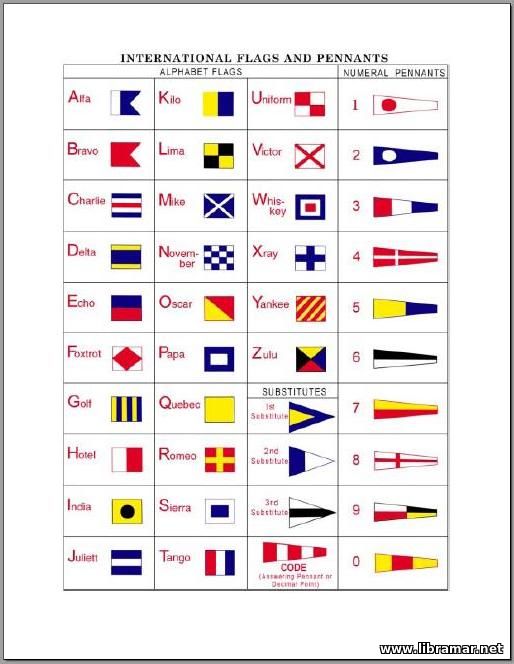 Well, here is a well known book - official updated and quite significantly revised edition of the Code of Signals. The main purpose of the present volume is to provide all interested parties, i.e. everyone involved in navigation, with the effective means and ways of communication in various situations essentially relating to the navigational and personal safety - this becomes even more important in cases when the language barrier and associated difficulties are there.
The book has been arranged in for major chapters. The opening chapter provides all readers with the general instructions for signaling. The second chapter of the book contains the general signal code while the third chapter contains the medical signal code. And, finally, the last chapter gives the distress and life-saving signals and describes relevant radio-telephone procedures. The main portion of the document has been supplemented with an appendix containing United States/Russian Federation signals for naval vessels.
The official title of this paper is Publication 102. It's very first edition was released more than a century ago, just imagine - in 1855, and it contained nearly seventy thousand signals using eighteen flags. Obviously, numerous important changes have been made to the Code since that, as a response to the developments in navigation and communication fields...
 One of the key declared functions of the ILO is the adoption of the international conventions and recommendations of the issues directly related to the labor and the work. The preset publication was issued by the ILO and it addresses such the important topics as tripartite consultation, collective bargaining, forced labor, industrial relations, labor inspection and administration, wages, social security, working time, employment policy, promotion of the employees, elimination of the child labor, protection of young persons and children, maternity protection, equality of the opportunity and treatment, social policy, migrant employees, AIDS/HIV related issues, vocational training and guidance, seafarers, dockworkers, fishermen, tribal and indigenous people etc.
This collection contains a huge number of the useful relevant documentation and will definitely be of great use to any person working at sea and willing to be aware of his or her rights. It will also be helpful to the shore workers of the shipping companies, human resource departments, ship officers and others responsible for continuing compliance with all requirements of the labor-related conventions and associated recommendations.
|