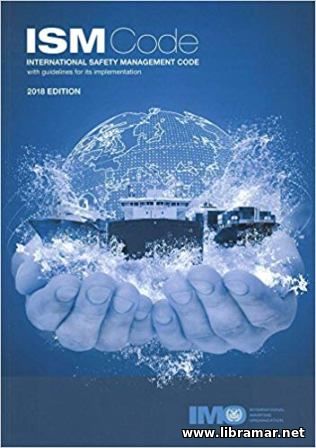
 The International Safety Management Code together with the necessary guidelines for the implementation was developed by the IMO in order to provide an internationally recognized standard to be applied to the safe operation and management of the vessels, and also for prevention of the environment pollution.
The document shall be considered a truly essential reference one for the owners and operators of the ships, ship constructors, maritime administrations, manufacturers of the shipboard engines and other equipment, education entities and training providers - virtually all people whose everyday work is connected with the ensuring of safety of human life at sea and pollution prevention.
The content of the document includes relevant portions of the SOLAS and ISM Code. In addition, it also provides readers with the guidelines for the operational implementation of the Code, and other important regulatory and guiding information.
The publication is a must-have for all people engaged in the shipping industry in one way or another. It is also an excellent training tool to the students and future auditors who shall possess a sound knowledge and deep understanding of all provisions of the ISM Code.
 This is a good collection of the classification and safety marks relating to the marine transportation of the dangerous goods. As we know, the carriage of the dangerous goods is governed by the provisions of the IMDG Code, covering nine classes of the dangerous goods, namely the explosives and gases, liquids and solids of flammable nature, organic peroxides and oxidizing substances, infectious and poisonous substances, corrosive and radioactive substances and, finally, all others combined under the umbrella of miscellaneous substances.
The booklet starts with the general introduction to the requirements of the Code and a general outline of the above listed classes together with their characteristics imposing additional requirements of their marine transportation. This is followed by the clear and concise explanations of the terminology applied. The main part of the document provides the safety marks that shall be used when the dangerous goods are transported on board your vessel. Note that the idea of the authors was to provide general introduction and not the detailed specific instructions on the transportation. The provisions of the IMDG Code and other relevant publications shall be referred to at all times.
 The latest edition of the SOLAS Convention released in 2018. This edition is the continuation of the previously released SOLAS 2009 and SOLAS 2014. This is the most important of the documents issued by IMO. Traditionally, at starting from the very first edition of the convention, its main objective remains providing the maritime shipping industry with the carefully thought and well developed range of necessary measures to improve the human safety at sea.
As you know, the original release of the convention took place in 1914 and since then the provisions of the convention are the must-do to the people who want to stay safe when working at sea. The text of this latest edition of the convention has been revised and updated in order to reflect all the latest technological development as well as all changes in the regulatory framework.
The arrangement of the material follows the regular pattern in use for the past decades and traditionally covers all important areas related to the safety of life at sea. Needless to say that a copy of the convention is a must-have document on board every single ship to which the provisions of the convention apply, and in the library of every single person involved in the maritime shipping.
 This is the official 2016 edition of the IMO IBC Code. The main declared purpose of the document is to provide the maritime shipping industry with the internationally recognized standard covering the safe transportation of the noxious liquid substances, i.e. NLS, and dangerous chemical substances in bulk form.
The provisions of the Code prescribe the standards that apply to the design and subsequent construction of the vessels carrying subject substances as well as the equipment that shall be carried on board in order to minimize any risk to the vessel, the crew members and marine environment. The content of the IBC Code is arranged in twenty-one chapters. The first one is introductory and pretty standard for most of the IMO-released publications.
It is followed by the chapters covering the survival capability of the vessel and cargo tanks location, arrangement of the ship including segregation of cargo, pump rooms, pumping and piping arrangements, ballast and bilge systems etc., cargo containment and transfer, construction materials, temperature control, venting and gas-freeing of the cargo tanks, electrical systems, fire protection/extinction arrangements, pollution prevention, human protection, instrumentation, applicable operational requirements, handling chemical wastes and other important areas.
 The present collection of files contains the IMDG Code 2016. It consists of two volumes of the Code itself supplemented with some additional information to be taken into consideration when applying the provisions of the IMDG Code. The main content of the IMDG Code has undergone significant changes over the past several years and its format has also been subjected to rearrangement.
This all was done in order to keep the Code in line with the rapidly expanding and developing maritime shipping industry. The Amdt. 38-16 contains the revisions made to the various parts of the IMDG Code including the requirements for transportation of the specific substances. The material of the Code is presented in two separate volumes and is arranged in seven parts.
The main body of the Code covers the general provisions, main definitions used in the document, security provisions and information on training of the personnel, classification of the dangerous goods carried on board ships, such as explosive, radioactive materials and others, packing and tank provisions, transport operations, consignment procedures etc.
There is a glossary of terminology provided in one of the appendices. Needless to say that the IMDG Code is a must-have publication on board every single ship engaged in the marine transportation of any dangerous goods.
 The present 2011 ESP Code was originally adopted in 2011 by Res. A.1049(2). It was later made mandatory through the amendments to Reg. XI-1/2 of SOLAS convention. Subject regulation requires oil tankers and bulk carriers to be subject to the enhanced inspection programme as per 2011 ESP Code.
The main purpose of the CAS, standing for the Condition Assessment Scheme, coming under the Annex I to the MARPOL convention is to verify that the structural condition of single hull oil tankers is acceptable at delivery of the vessel and continues to be acceptable - this is verified through periodical surveys.
The content of this Code consists of two annexes. The first Annex A covers the single-skin and double skin bulk carriers, while the Annex B is dealing with the double-hull oil tankers and other oil tankers. The Code is closely aligned with the content of IACS UR Z10 addressing hull surveys to make sure that it is kept user friendly and simple.
The publication is definitely a must have on board any bulk carrier and oil tanker and will also be interesting for the people working in a maritime industry and willing to be knowledgeable about all requirements that may be applied to the subject vessels.
 Draught survey is a common method widely used for determining the weight of the bulk cargo transported by sea, and particularly coal cargo. The accuracy provided by these surveys vary. There may be some discrepancies between the loading and discharge results that lead to the commercial disputes between the parties involved including ship operators, sellers, buyers, marine surveyors etc., because the weight of the cargo is considered a basis for calculating the payment, port fees and freight.
Taking into account increasing value and volume of the coal trade, the shippers and receivers of the cargo are becoming seriously concerned about these discrepancies. That is why there was a need for the procedures and standards to be followed during the draught surveys.
The present Code contains the full set of recommendations to be used when conducting draught surveys and is expected to benefit absolutely all parties; it is also intended to provide valuable contribution to the implementation of the internationally recognized trade practices. It's main purpose is to make the above mentioned procedures uniform and give practical reference to the draught surveyors who may follow its provisions.
 The present Code was released by the ILO with the intention to serve as a concise yet complete set of recommendations developed on the basis of the established good practice in the shipping industry. The advise provided in this volume will be useful to all persons and entities directly concerned with the health and safety in marine port works including employers and official authorities, equipment suppliers, manufacturers, workers and others.
It should be noted that some of the provisions of this document may not apply to all regions and all countries. Sometimes they will have to get adapted to the local conditions. The history of the international maritime shipping port industry dates back to the very earliest days of human civilizations. And since then the industry has developed so steadily. But the methods of handling shipboard cargo that used to be quite dangerous and arduous remained same until that time when the containers and ro-ro systems were introduced.
There have been numerous significant technical developments since that time. This volume starts with the general provisions followed by the information on the infrastructures of the ports and associated equipment, lifting appliances and their safe use, operations afloat and on shore, handing of the dangerous goods, PPE, health issues etc.
|