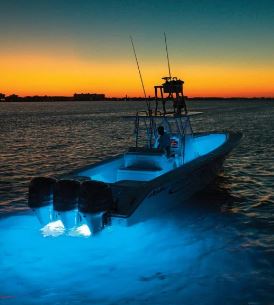
Running your boat at night can be a wonderful experience, or, under other circumstances, can be downright scary. If you're planning a cruise at night, the easiest way to avoid problems is to confine your route to open water offshore. Shipping lanes should be avoided. Inshore waters and intercoastal waterways present the most hazards when boating at night.
You may not be able to visually observe unlighted daymarks and buoys. Another problem is that lights ashore can make identifying lights for aids to navigation very difficult. So can lights on other vessels. Also, running aground in shallow water, or running into obstructions, is several times more likely to occur inshore than offshore. On many of our waterways, especially those that are heavily traveled, there are many things that you can hit in the darkness. But just as important, there are many things that can hit you. So the first consideration, of course, is to make sure that you can see well enough, and that others can see you.
Spotlights are always a good item to have aboard, if used properly. If not, they can cause problems for you as well as other boaters. If you're looking ahead into the path of a brightly lit area of water, your side vision will be affected.
Your ability to see in the dark, or night vision, is not very good under these conditions, and you may not be able to spot red or green lights of another boat or a buoy. A spotlight also can temporarily blind other boaters. Unlike the headlights of an automobile, spotlights point in any direction, and traffic can come from any direction. Even if you're using your spotlight to, say, read the numbers on a buoy, using it temporarily affects your night vision. So it's a good idea to have someone who is not operating the boat to use the spotlight for such things.
Some are well-lighted, and some are not. If you haven't done so, check your helm lights out after dark, prior to a scheduled night departure. Most gauges, such as tachometers and fuel gauges, have built-in lights, so make sure they're working. Ideally, you want to be able to see the instruments easily without the lights affecting your forward vision. Too much light at the helm can blind you when you're looking ahead.
Charts needed for your night voyage should be readily accessible but stored in a dry place. A light to see them, whether built-in or handheld, is of course very necessary. If possible, avoid having to hold the flashlight while using the chart, especially if you must run the boat at the same time.
If at all possible, avoid running the boat while you're looking at a chart. If you can get assistance, use it. Looking at a brightly lit chart and then looking ahead into the darkness can be dangerous. It takes time for your eyes to adjust to the change. It's just not a good idea to read a chart and run a boat at the same time. But if you must, slow down and continue to look ahead, especially if you're in close quarters or traffic.
The lights you use to read charts should be red-filtered. This will help you keep your night vision. Other lights on board, such as deck lights, may be useful in moving about the boat, but they should never interfere with a skipper's night vision or be confusing to another vessel when observing the navigational lights.
Before departing on a night cruise, there's a lot of preparation to be done. In addition to the normal checklist of items for any cruise, night conditions require other special considerations. Navigation lights, running lights, anchor lights, and special purpose lights, they should all be tested. They tell other people something about your boat, whether you're running under power or in a rowboat or sailboat. They also indicate you're anchored if you choose to do so. Remember, technically, you are underway if not anchored or tied up on the shore somehow.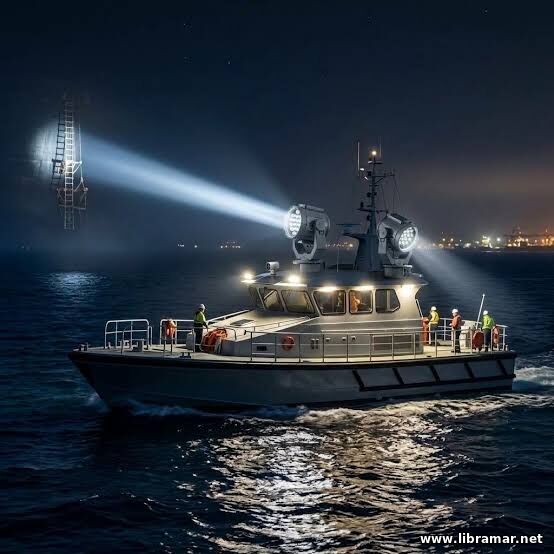
Navigation lights on your boat also tell others in what direction you're headed in relationship to their position. And, since sound signals also play an important role in boating at night, it's a good idea to check your boat's horn. A backup horn or sound signal device would be advisable. The need to sound a warning signal may be more prevalent at night than during daytime operations.


