 All of us live in countries where there are laws and governing bodies telling us what we can and cannot do. However, 70% of the world is ocean, where there are no countries and, consequently, no governing bodies to tell people what is right and wrong. That is why maritime law exists.
Let us start with a hypothetical: a baby is born on a cruise ship sailing in the middle of the Atlantic Ocean. What nationality does he or she take? On the picture the coast of some fictional place in some fictional country governed by some fictional government is shown. From the white line, which is the water line at the lowest low tide, every country is allowed 12 miles of territorial waters. In the past, it used to be 3 miles – the distance a cannon could shoot off shore, but that has since changed.
Those twelve miles are the property of a country. They can do pretty much whatever they please in it and all domestic laws apply. Foreign ships are, however, sometimes allowed into these waters under the principle of innocent passage. If ships have innocent purpose – which does not include fishing, polluting, weapons practice or spying – they are allowed to pass through territorial waters of a foreign nation without permission as long as they do so quickly and without stopping on ashore.
 Every now and then we hear yet another story about a nighttime collision at sea, maybe between a ferry and a yacht or even between two large ships. Either way, the same question always comes up – why did not they see each other?
Sure, if it is nighttime, it is harder to see things, as you must have noticed it yourself when driving at night, you need headlights to stand a chance of seeing anything. Yet, when you look at a ship at night, they do not have headlights.
But why? If the headlights work fine for car, why not for ships? Well, think about what a headlight actually is. It is just a source of light, designed to emit photons which can bounce off objects and return to your eyes. Your brain then interprets them and tells you what you are seeing.
Simple enough but you need a light powerful enough to illuminate the area you are looking at. The power from the light is dispersed across the full width of its beam. Then, when the light hits an object, small bit of its beam that hits the object is reflected back, but it is again dispersed, meaning that only a tiny fraction of the original light gets back to you.
That is fine in a car, you want to narrow the area right ahead of you extending out far enough that you can take action to avoid the things that you see. Even at motorway speeds around 100 meters should be enough. You are probably starting to see where I am going with this.
With a ship 100 meters may not be enough to see your own bow, let alone to see far enough ahead to take any action. A large cargo ship, for example, needs more than a mile to stop. With two such vessels approaching each other, you are looking at needing at least two miles visibility to take action in time. You know how bright a car’s headlight is. Just think how much brighter a ship’s headlight would need to be to have the same effect!
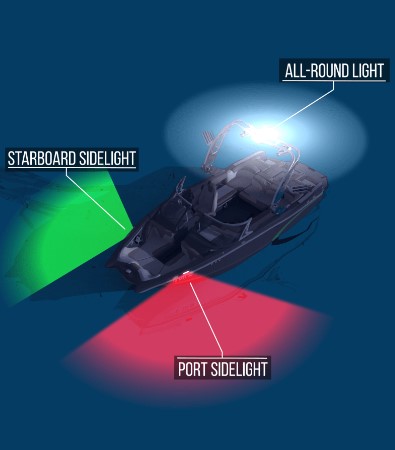
Imagine two ships approaching each other at night. We have already established that they do not use headlights to see each other. So, what do they use? Well, they still use lights, but they are called navigation or nav lights instead. Every seaworthy vessel is fitted with nav lights the idea is that they are arranged in a standardized distinctive way so that other vessels can not only see you, but also identify how you are moving. As nav lights are fitted to the target vessel, their power only needs to be sufficient to be seen by other vessels.
If you have a light fitted as shown on the picture, rather than just relying on a tiny portion of reflected light, you can see how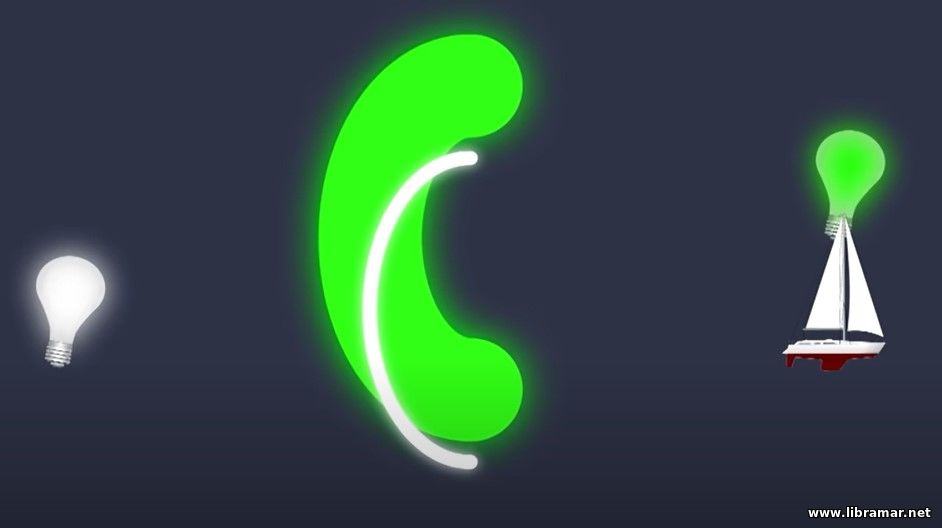 much easier it will be to see compared to using a headlight. much easier it will be to see compared to using a headlight.
But what about identifying their movement? Let us take this cargo ship as an example. She would show two masthead lights, the aft one being higher than the forward one. These immediately tell other ships in which direction she is moving. But she also shows sidelights. These are the colored lights that you probably know about – red for port and green for starboard. Again, it reinforces, which way she is traveling.
But the lights can tell us even more than that. If we are looking at the vessel’s port side and she turns towards us – as the masthead lights come in line, you can start to see both sidelights. You know the other vessel is heading straight for you. Take the look from above and you can see that the only angle where you would see all those lights is from right ahead. The observant among you will spot that these lights do not go all the way around either. Instead, we have a single white light filling in the sector of the stern, as shown on the picture. What this means is that if you spot a single white light, one of the things it could be is a power-driven vessel viewed from a stern.
If she turns a bit you can come on the cusp of viewing her sidelights and mast headlights, too. Looking from above, the only thing where this is possible, is along the white line shown – it is two points of 22.5 degrees above the beam – the very definition of overtaking we took straight from COLREGs.
Of course, we just looked at a power-driven vessel here but there are countless variations on this arrangement. You can 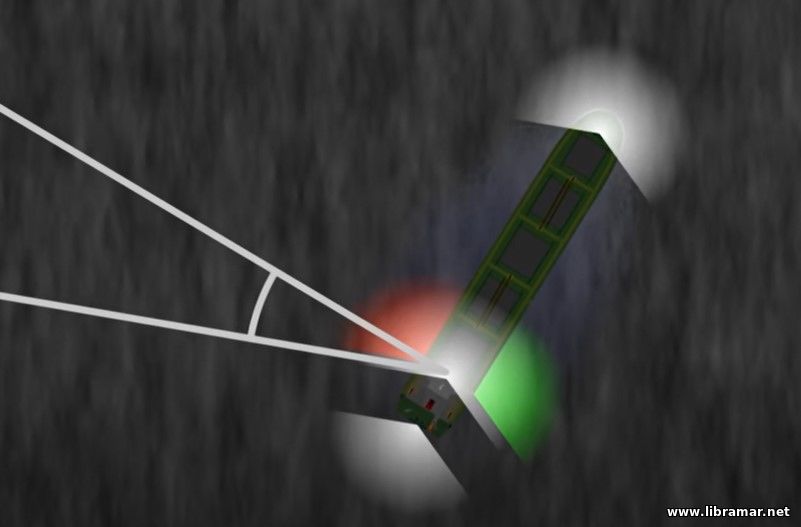 add extra mast headlights to indicate you are towing or show only side lights to indicate you are sailing. You can even modify your status by adding two all-round red lights to show you are not under command, or three all-round red lights to show you are aground or make the middle one white to show that you are restricted in your ability to maneuver. add extra mast headlights to indicate you are towing or show only side lights to indicate you are sailing. You can even modify your status by adding two all-round red lights to show you are not under command, or three all-round red lights to show you are aground or make the middle one white to show that you are restricted in your ability to maneuver.
See, nav lights tell you so much more that headlights ever could. They accomplish the basics making the vessel show up against the dark sky. But, in addition, they allow you to identify the vessel type, work out its aspect, and see which way she is moving – all vital information when it comes to applying the collision regulations, and working out which of you needs to give way to the other.
 It is very important to understand the importance of the shipboard communications at all levels in order to achieve safe and efficient ship operation. What is communication? Here is one possible definition – transferring signals and messages from one person to another with the purpose of creating an understanding, a particular meaning or a certain reaction from the other person. If no reaction is received, we are talking about one-way communication.
According to statistics, as much as 70-80% of incidents and accidents at sea can be traced back to some kind of communication problem including those between personnel on the bridge because of different culture, native language, age, experience etc., between bridge and engine personnel, ship and tugs, ship and VTS, ship and ship owner/operator, ship and authorities.
 Have you noticed how boats, both large and small, tend to be painted a different color under the water? Most often, it is red but actually nowadays you can get any color you like. The reason for it goes back to the earliest days of sailing ships. Back in those days wooden sailing ships would slowly plot around the world. A combination of their slow speed and rough hull made them an ideal breeding ground for underwater growth. Just take a look under a pier and you will see the sort of marine growth these ships used to suffer. We are talking barnacles, worms, seaweed, and things like that, so that is the issue.
Well, all of these things have negative impacts on ships over time. You get the obvious of things like damage to the hull itself due to worms and the actual growth; then you get issues like the additional weight that they have to carry around and reduction in maximum speed due to the extra drag. Of course, on sailing vessels that drag-on weight would impact their ability to sail upwind which would yet further reduce their efficiency. What you need is a way to stop marine life from growing on the bottom of the hull and this is where antifouling comes in. this is where antifouling comes in.
Antifouling is just a system designed to reduce fouling by animal and plant life on the underwater sections of a boat or a ship. Early solutions were to place copper sheets on the hulls of ships. The “Cutty Sark” is a great example of this. The primary purpose of the copper sheets was actually to stop worms eating their way through wooden hulls. A secondary benefit is that the copper would reduce the growth of plant life.
Of course, as wooden hulls were replaced by iron, worm issue did reduce but they have never been eliminated. Just look at the leisure industry today and you will still see a plenty of wooden hulls around, and of course regardless of its construction materials we still have the same old issue of drag caused by the growth of plant life is probably more important now to keep that under control, considering the costs of fuel and efficiency savings on long passages.
We still need antifouling to stop a combination of worms, barnacles and weed from growing on the underside of the hulls but instead of using the old technique of copper sheets we now use a form of paint. The subject paint works on the same principle and actually still uses copper as a biocide though it is mostly cuprous oxide mixed with the paint rather than copper sheets.
It is the natural red color of those copper oxides that has led to the traditional red color of antifouling. Modern antifouling systems can be broken into two broad categories – hard and soft. Soft coatings are designed to wear off over time continuously exposing  fresh biocides as the outer layer of the paint wears off. Hard coatings, on the other hand, are designed to be lot more durable. They are meant to last a lot longer. As the biocides are released the durable layer of paint remains but the biocides contained in the outermost layer do get used up. fresh biocides as the outer layer of the paint wears off. Hard coatings, on the other hand, are designed to be lot more durable. They are meant to last a lot longer. As the biocides are released the durable layer of paint remains but the biocides contained in the outermost layer do get used up.
Both systems work on the same principle. They gradually release biocides commonly based on the chemical element copper. The difference is that the soft coatings allow the paint to flake off as well. As you can imagine, there are environmental considerations – antifouling releases biocides and possibly paint into the environment. That is one reason a lot of ports do not allow cleaning the hulls. They do not want the extra dose of biocides and paint released by the rubbing process.
One of the other options is to use the normal hardware and paint on the other side of the hull but that will result in a lot of aquatic growth. That is fine on a small boat that you can pull out of the water and clean quite often, but is not so great on a container ship running around the world. What would happen if, for example, container ship picked some weed in Asia and carried it into the Baltic Sea where it takes hold and overtakes some of the native species? Similar things have happened and do actually continue to happen though it is not so much from hull growth because antifouling is more of an issue for the ballast water.
So, aside from just using no antifouling, what could you do? There is a talk of systems that slowly use some sort of jelly from the hull. The theory is that as the growth attaches to the hull, the jelly seeps off and takes the growth with it. There are also some silicon based paints that make it hard for barnacles to stick to the hull. Unfortunately, these do not actually stop the growth but it makes it easier to clean off.
As said above, most ports do not allow cleaning anyway not only because of the historical antifouling issues but also they do not want to clean off species that are not native to the harbor itself. The last thing they want is to be overcome by some sort of invasive weed from the other side of the world.
 Bridge resource management is such a vital part of the ship safety that it is requirement of the STCW convention and the ISM Code. It is a method which uses all resources available to conduct safe and efficient vessel bridge functions. These resources include both equipment and personnel. It takes both traditional skills to operate the equipment as well as managerial skills to use personnel resources to their potential. In order to best utilize personnel o board your vessel, you must understand the human factors involved. These include communications, situational awareness, stress, fatigue, leadership and decision making, and group dynamics and integration.
The NTSB has determined that human factor contributed to 75-80% of all marine casualties. That is why the STCW has made a requirement that all shipboard officers must demonstrate an understanding of the concepts which constitute effective Bridge Resource Management. Note that it is important to establish good vertical communication including making sure to include unlicensed personnel. unlicensed personnel.
The bridge personnel’s performance is essential to the safety of the vessel. In order to achieve a sound and efficient bridge organization, defined procedures including Master’s standing orders are essential. Procedures shall be established to ensure duties are clearly defined and assigned to certain individuals. Effective procedures will minimize the risk that an error by one person will have disastrous and irreversible consequences. No one should be assigned more than they can handle, and no duty should be re-assigned without notifying the watch officer.
A visual lookout should always be maintained. In good visibility, it is good practice to periodically undertake collision avoidance routines in order to be fully prepared if difficult situations subsequently arise  and reduce visibility. and reduce visibility.
To cope with the workload and risks, specific watch conditions should be established for restricted visibility, heavy traffic, and pilotage conditions. It is important to make sure that all equipment needed is available and functioning. If equipment is not functioning, its limitations and errors should be correctly applied. Pilots are valuable addition to the bridge team; there must be a good exchange of information between the pilot and the bridge team so each is aware of the other’s intentions.
In assigning duties, careful consideration should be given to the ergonomic layout of the bridge. The concept of the zones and responsibility takes this into consideration and duties are assigned so that personnel are not interfering with each other but can share critical information. Checklist should be used but not treated as a substitute to the thorough knowledge of the ship or procedures. Checklists have many benefits, such as focused attention at the task at hand, helping to establish priorities, serving as an aid against failure of human memory, helping to balance the workload, and eliminating guesswork by instituting standard procedures. The STCW convention requires that new crew members be given familiarization training prior to assuming any duties, and Masters and mates have knowledge of Bridge Teamwork Principles.
 Narrow passageways and fairways in rivers and canals with a navigable depth and width comparable small in relation to the draft and the breadth of passaging ships are called restricted waters. The maneuverability of ships navigating through such restricted waters will be affected by high hydrodynamic effects that are different from those when ships navigate in broad and deep waters. These peculiar hydrodynamic effects are the shallow water effects, ship squat, interaction and bank effect. Let us have a look into the shallow water effect and ship squat.
When a ship proceeds, the surrounding water is displaced toward the sides and bottom, making a relative flow against the ship’s advance. Advancing hull submerges deeper compared to when she is dead in the water; this changes the trim because the water  around the hull flows a little faster compared with the ship’s speed and the hydraulic pressure decreases. This phenomenon is called ship squat; but why does this take place? around the hull flows a little faster compared with the ship’s speed and the hydraulic pressure decreases. This phenomenon is called ship squat; but why does this take place?
In shallow water, when the bottom clearance is comparatively small, the ratio of the horizontal flow along both sides of the ship increases because the current towards the bottom is restricted. The hydraulic pressure along both sides of the hull decreases, as the nearer hull is to the surface flow, the faster the rate accelerates and the water level around the ship drops considerably. For this reason, sinkage of the bow and stern and subsequent trim change become larger in shallow water than in deep water. We should be careful that sinkage of the bow and change of trim become greater when a ship  runs in shallow water. runs in shallow water.
Now let us see how the depth of water affects the turning capability of the ship in shallow water. We will have a look at the data of the turning capability of the large ships. Every curve indicates the tactical diameter of a specific ship by the multiples of the ship’s length. There is another graph illustrating how the turning track of the ship differs as the depth of the water changes. Note that in both cases, the ratio of the water depth to draft is changed with all other parameters remaining same. Thus, we can estimate the tactical diameter of a ship running in restricted water as the multiples of its length, although the presented data are taken from the test results of the large ships, this method can also be applied to smaller ships.
 In view of the maneuverability of a ship, the depth of water also affects course stability like the effects on turning ability. We shall study the difference of the effects on course stability in deep water and in shallow water from the results of the zigzag maneuver tests. In the zigzag maneuver test a ship’s rudder starts to swing alternately to port and starboard when the ship is set on the steady straight course. At first, the rudder is put to starboard ten degrees until her head swings starboard ten degrees from her original course. Immediately after the ship’s head swings ten degrees starboard, the rudder is changed to port ten degrees until her head appoints ten degrees port from her original course. In view of the maneuverability of a ship, the depth of water also affects course stability like the effects on turning ability. We shall study the difference of the effects on course stability in deep water and in shallow water from the results of the zigzag maneuver tests. In the zigzag maneuver test a ship’s rudder starts to swing alternately to port and starboard when the ship is set on the steady straight course. At first, the rudder is put to starboard ten degrees until her head swings starboard ten degrees from her original course. Immediately after the ship’s head swings ten degrees starboard, the rudder is changed to port ten degrees until her head appoints ten degrees port from her original course.
This alternate rudder operations are repeated several times making a ship run in a zigzag course. On the picture you can see the results of the zigzag tests conducted in deep and shallow water. The required time to turn a ship’s head port or starboard to a settled angle in shallow water become shorter with a smaller overshoot angle than that in deep water. This means that we can expect quicker rudder effect in shallow water compared to that in deep water.
A well-remembered case among several cases reported in the past is that of a large passenger ship navigating in shallow water without reducing the speed that hit her bottom severely on the rocks. When running in restricted water, it is essential to keep enough underkeel clearance to avoid the deterioration of the maneuverability and touch bottom damage.
Underkeel clearance means the space between the ship’s bottom and the sea bed. It equals the value when the ship’s draft is subtracted from the sum of chart datum and  height of tide at that time. To maintain enough underkeel clearance, we have to consider the factors affecting the sinkage of the hull such as squat allowance, wave response allowance, possible error of chart datum, meteorological and oceanographic conditions, and other environmental conditions, and secure a safety allowance that eliminates ship handling difficulties. height of tide at that time. To maintain enough underkeel clearance, we have to consider the factors affecting the sinkage of the hull such as squat allowance, wave response allowance, possible error of chart datum, meteorological and oceanographic conditions, and other environmental conditions, and secure a safety allowance that eliminates ship handling difficulties.
The effects of sinkage and change of trim when a ship navigates in shallow water greatly affect the ship’s maneuverability. Enough knowledge of these effects in restricted waters will prevent accidents.
 This short article is devoted to the practical use of ECDIS as an aid to navigation and the usage of the common features and functions in a safe and efficient way during the voyage of your vessel. The ECDIS system is only one of many complicated electronic navigation aids found on today’s modern ship bridges. To navigate his vessel safely and efficiently, the navigator must have a good navigational background, sufficient navigational practice, theoretical knowledge about the ECDIS system architecture, functions and features, and practical experience in the use of ECDIS systems.
An ECDIS system is a very impressive system even when seen through the eyes of the professional navigator. But no navigator should ever forget that all systems do have limitations and the fact that these limitations are very often well-hidden and/or not mentioned in the system manuals. The most important thing to know about modern computerized systems is their limitations. Knowledge concerning their functions and features is quickly accessible with a little interest and practice. The only way to get to know the limitations of the system is to study available material about the subject, system manuals, and by practical use under safe conditions.
As of today, the Seafarers Training, Certification and Watchkeeping (STCW) Code does not specify any special training in the use of ECDIS. STCW table A-II/1 considers the ECDIS training to be a part of training in understanding a “chart”. As a modern ECDIS system is just as complicated as ARPA, this lack of detailed training requirements may pose a hazard to ships, sailing with ECDIS operated by untrained operators.
The reduction of presented information or proper selection of only relevant information is often an important task when setting up  an ECDIS system. An ECDIS system which simultaneously presents all available information tends to be overloaded and therefore the important information may be less visible. A basic and very important thing to understand and take into account at all times when using ECDIS is the fact that no system is better than its weakest chain, that is, “rubbish in – rubbish out”. Vital information for any ECDIS system is own ship’s position. Whenever own position is wrong, ECDIS chart information is wrong. Simple as that! an ECDIS system. An ECDIS system which simultaneously presents all available information tends to be overloaded and therefore the important information may be less visible. A basic and very important thing to understand and take into account at all times when using ECDIS is the fact that no system is better than its weakest chain, that is, “rubbish in – rubbish out”. Vital information for any ECDIS system is own ship’s position. Whenever own position is wrong, ECDIS chart information is wrong. Simple as that!
information is wrong. Simple as that! ECDIS systems accept position input from a number of positioning devices as well as dead reckoning. Most ECDIS systems today are connected to a GPS and/or DGPS. This means that stable and good positioning can be expected most of the time. However, the navigator should never forget to check his position as often as practicable by all available means in order to detect any malfunction or inaccuracy in the navigation system used as an input to the ECDIS.
Positions are always referenced to “something” and this “something” is referred to as the chart datum and there are hundreds of different chart datums around. This means that the navigators at all times must know:
- What chart datum does the ship’s positioning system connected to the ECDIS use
- What chart datum does the actual ECDIS chart use
- Whenever the datum used by the positioning system and the chart are different, known corrections must be taken into account.
Today, the ECDIS system is often connected to an integrated bridge system, of forms a part of an integrated bridge system, i.e. a system where the Radar, ARPA, Autopilot, Positioning, Routing, Log, Gyro, ECDIS etc. are connected and work as “one system”. Several options for “automatic sailing” become available to the navigator. Depending on the ship position, i.e. open sea, coastal or restricted waters, the navigator may select between several sailing options. The examples of possible sailing options found on an integrated ship bridge system include course mode, corrected course mode, and track mode.
Course mode is a sailing mode normally used in open waters and for long distance sailing, as this mode will give the shortest distance between two points. No correction for offset is made, but the ship will “home” to the destination.
Corrected course mode is used in waters where it is necessary to correct for wind and current. Correction for offset is made, but no attempt to follow the original planned track is made.
In track mode, the system will calculate the optimal path back to the original planned track. This mode is used in restricted waters whenever it is important to stay exactly on the planned track.
 For a professional navigator, it is a matter of course that the route selected for actual sailing is properly checked before it is activated and used for actual sailing. Parameters used when planning the route must still be valid in order to maintain required safety margins. If not, the route may have to be changed before it can be used safely. Examples of parameters which may have changed after the selected route was programmed are ship draft, available position accuracy, engine and steering gear reliability etc. For a professional navigator, it is a matter of course that the route selected for actual sailing is properly checked before it is activated and used for actual sailing. Parameters used when planning the route must still be valid in order to maintain required safety margins. If not, the route may have to be changed before it can be used safely. Examples of parameters which may have changed after the selected route was programmed are ship draft, available position accuracy, engine and steering gear reliability etc.
Navigation with an ECDIS system, especially when the ECDIS is connected to an integrated bridge system, changes the work situation for the navigator a lot. Conventional navigation with manual plotting of ship position in the chart, heavy traffic, and manual course change in restricted waters is a task that puts a heavy workload on the navigator. A good working ECDIS reduces that workload a lot. So, the navigator’s role has changed from actually doing the tasks to monitoring them. From the safety point of view, this should be very good, as the navigator is given more time to check important parameters and monitor the traffic more closely.
Sailing with ECDIS requires a highly qualified navigator with a sound and positive skepticism towards computerized systems. Take the necessary time and effort to really get to know your ECDIS. This will definitely save you lot of work and trouble in the future; it may someday save your career or even your life.
 The basic inspection regime for all the MOUs is the IMO conventions. These include the Load Lines, SOLAS, MARPOL, STCW, COLREG and Tonnage conventions. Some MOUs also examine compliance with the relevant ILO conventions. Ships can check each MOU’s website for the further requirements. Complications can arise because for all members of MOUs, their national legislation will take priority over the MOU agreements.
MOUs have different levels of inspection. The initial inspection usually takes about three hours. If there are clear grounds to concern, it may progress to a more detailed inspection, adding another hour or two. Ships with a poor inspection history may be subject to a more detailed inspection. If the Master believes that port state control inspection is likely, he should double check the gangway watch. An ineffective or absent gangway watch will start the inspection badly as it implies poor compliance with the ISM Code. A proper gangway watch must always be in place. The ISPS Code must be strictly kept to. Ships with high target scores, such as old bulk carriers, passenger ships, oil tankers and gas and chemical carriers, will be subjected to an expanded inspection which will take six to eight hours.
MOUs have different levels of inspection. The initial inspection usually takes about three hours. If there are clear grounds to  concern, it may progress to a more detailed inspection, adding another hour or two. Ships with a poor inspection history may be subject to a more detailed inspection. If the Master believes that port state control inspection is likely, he should double check the gangway watch. An ineffective or absent gangway watch will start the inspection badly as it implies poor compliance with the ISM Code. A proper gangway watch must always be in place. The ISPS Code must be strictly kept to. Ships with high target scores, such as old bulk carriers, passenger ships, oil tankers and gas and chemical carriers, will be subjected to an expanded inspection which will take six to eight hours. concern, it may progress to a more detailed inspection, adding another hour or two. Ships with a poor inspection history may be subject to a more detailed inspection. If the Master believes that port state control inspection is likely, he should double check the gangway watch. An ineffective or absent gangway watch will start the inspection badly as it implies poor compliance with the ISM Code. A proper gangway watch must always be in place. The ISPS Code must be strictly kept to. Ships with high target scores, such as old bulk carriers, passenger ships, oil tankers and gas and chemical carriers, will be subjected to an expanded inspection which will take six to eight hours.
Under the Paris MOU, the ship is obliged to inform the port if it believes that it is due for the mandatory annual inspection. The Paris MOU website lists the types of ship for which this is required. Always ensure that the PSC officer is escorted to the Master’s cabin. Be aware that the inspector will be looking around to see the state of the ship.
|