 The FEM is considered one of the best numerical methods used to solve the differential equations describing many various engineering problems. This new publication is covering the fundamental theory of the final element method including appendices on each program. The authors have introduced the concepts of this method enabling engineers to use it efficiently and also to properly interpret the obtained results.
They will learn all finite elements including one, two and three dimensional elements. The book is written excellently; the readers will definitely enjoy the examples provided in the book and illustrating the concepts. The book has been found to be among the best available resources to learn the FEM, suitable for the graduate and undergraduate levels.
The content is perfectly organized and procedures are well explained and illustrated. Some of the relevant programs including MATLAB and ANSYS have also been covered and provided with detailed explanations. This is highly recommended volume to the people willing to have a clear idea about the FEM and its applications and understand the fundamentals of this method to be able to apply it.
 The UMV, standing for the unmanned marine vehicles, is a collective term which is commonly used for describing the autonomous vehicles operating under the surface of the water, ROVs, i.e. remotely operated vehicles, unmanned surface crafts and semi-submersibles.
In fact, the content of the present volume continues to familiarize readers with the advances in UMV, the process commenced within the original publication by these authors coming under the title Advances in Unmanned Marine Vehicles, published about ten years back.
Nowadays, there is quite considerable interest in these vehicles shown by the military, scientific and even civilian communities planning to undertake different missions while being autonomous or working together with some other vehicle.
This volume addresses many important topics, for instance the navigation guidance and controlling the UMVs etc. Recommended to the people with professional interest in the subject, willing to be in line with all latest developments in the field.
 When working on this volume, the author was pretty aware of the huge scope of the contemporary vessel design as well as the difficulties faced by the designers trying to place the different elements in the correct perspective. The significant increase in the world tonnage has eventually resulted in the progress with this task, and that is why the need for the food review appeared.
Apart from the discussions on the newly introduced design techniques, the content of the present title also focuses on the essential theory of the naval architecture, without which it would bake little to no sense to proceed any further. Every effort has been made to present the material in the way that would make it understandable to the students; it should not be, however, treated as the mere textbook of naval architecture.
The real intention of the author was to introduce students to the general scope of the most important areas of ship design. The volume is therefore highly recommended to the students of the naval architecture and ship design faculties; however it will be of practical use even to the specialists willing to improve or refresh their knowledge of the subject, expanding it to cover some new areas.
 This volume shall provide the students with the fundamental technical skills normally required when making a broad range of piping-related drawings. The content of the publication is presenting a detailed approach to the basics that all students will need in order to start a successful career in the field of design and drafting.
The opening chapter of the volume provides a quick yet comprehensive overview of the opportunities existing there in design and drafting for the people mastering the fundamental skills presented in the other parts. Each of the chapters continues a preceding one. That is why it is recommended to master the concept of particular chapter of the book prior to proceeding to the next chapter.
Note that there are exercises and questions provided at the end of each chapter included to assist the students in the review and further practicing the concepts of the subject chapter. The book covers the steel piping, pipe fittings, basics of flanges and valves, mechanical equipment, flow diagrams and relevant instrumentation, applicable technical codes and specifications, layout of the equipment used, drawings and sections, isometrics, 3D-modeling and many other important topics.
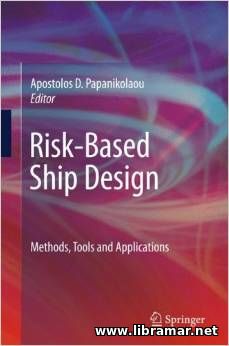 The risk-based design of vessels is a newly established engineering area attracting more and more interest of the practicing designers, engineers and researchers from the various disciplines connected with the design and construction of ships, their operation and regulation.
There is a twofold motivation to use the risk-based approach - the implementation of a novel design considered safe but not yet approved or rational optimization of the existing design focusing on the safety but bearing the performance and efficiency in mind.
The content of this book derives from the information and technical knowledge obtained during the SAFEDOR project coordinated by GL. It is not the intention of the author to prepare a text-book for the ship design students noting that the contributors to this volume are still evolving. However, the volume is aiming to provide readers interested in the risk-based approaches to the ship design with a good understanding of the basic and details of these approaches and their integration.
The volume will facilitate the transfer of the knowledge gained in the course of the project to the whole maritime community and shall therefore be treated well since such transfer will play a very important role in improvement of the ship design techniques and eventually contribute to the safety of shipping.
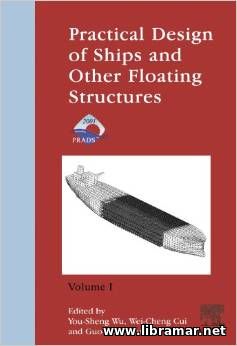 This publication contains the proceedings of the Eighth International Practical Ship Design Symposium which was held some years back in China. The author has collected the most important and relevant materials presented in the course of the subject symposium. The main aim of that world experts meeting was to discuss the latest advances in the field of ship design as well as professional disciplines, to exchange the knowledge and experience and promote further discussions.
The materials are arranged in three sections. The first section covers the design synthesis for the ships and floating systems, including life cycle cost considerations, optimization tools, parametric ship hull form design, impact loads, CFD tools used for the wave cancellation optimization, probabilistic analysis tools, and many other issues. The second part deals with the production and covers the composite materials, newly introduced production systems, welding distortions, innovations etc.
The last chapter is devoted to the hydromechanics and deals with the viscous flow and associated calculations, wash and wave resistance, simulation techniques, flow behavior, parametric studies, experimental and numerical evaluations, ship model tests, continuous wavelet transform and many others interesting topics.
 The content of this publication prepared by the group of leading experts is intended to describe toe newly introduced methods applied to model the machine dynamics used in today’s offshore industry. Subject methods are normally based on the rigid FEM (i.e. finite element method) – this method is utilized when addressing the link deformations. In addition, they are also based on the homogeneous transformations – in turn, this one would be applicable to the dynamics of the multi-body system.
The authors of this book provide a good introduction to both methods so that the readers can have a clear idea of the associated principles. The models that are selected to model the above mentioned dynamics are subsequently verified through the special FEM-based software. Some of the additional calculation methods are also applied.
The math models of the offshore machines, for example the BOP gantry crane, or the machinery used for laying pipes, have been included by the authors to better illustrate the theory. Additionally, selected numerical operation simulations have also been provided. The publication will of particular interest to the designers of the various offshore facilities.
 The book shall be looked at as a truly comprehensive professional treatment of the MMS, standing for the marine mooring systems, that are commonly involved in such critically important processes as offshore oil exploration and mineral recovery. The author has covered such topics as the stability analysis of the flexible riser systems, robust adaptive control, non-linear dynamic modeling and many others.
The book shall be treated as a very authoritative reference on the control and dynamics of the marine mooring systems. The readers of this book will gain a full picture of these systems and also will get much better understanding of the effective technical considerations and solutions to the problems usually arising from dealing with MMS.
The text of the volume provides a complete coverage of the dynamical analysis/control for MMS, newly obtained results of the installation, riser and mooring systems plus general modeling methods, approximation-based schemes of control by means of the neutral networks etc.
|