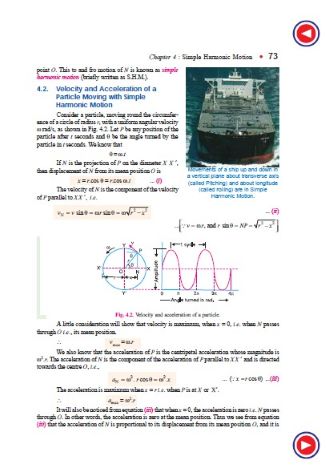
 The present file, or e-book, will be greatly appreciated by the people involved with mechanical engineering, including both professionals and the students. The content was prepared by the collective of mechanical engineering experts who shared their knowledge and experience, not only purely technical, but also considering the way of presenting the material.
Their combined efforts have eventually resulted in this brilliant publication. Note that the present volume was computer-based from the beginning, no scanning as such. Meaning, that it is easily searchable and also provided with some additional features for better navigation across sections and throughout the text.
The book is really big, so the authors managed to put it all in a single volume, covering literally all important areas of mechanical engineering, such as the kinetics and kinematics of motion, simple mechanisms, simple harmonic motion, velocity using the instantaneous and relative velocity methods, acceleration, friction, inertia forces, toother gears, and so many others, up to and including automation.
 We all know what the term reliability means. This second edition of one of the most popular books on mechanical reliability will provide readers with lots of useful information and knowledge about it. So many ideas have been significantly developed since the first edition of the volume, and the current one reflects all latest happenings in the field. Although the content of the book has been revised and rewritten, the author's approach remained same.
The general format of the publication has also remained unchanged. The opening chapters of the volume provide general introduction to the subject and definitions used throughout the text. The glossary of commonly used terminology is also there. The first chapter of the main part is devoted to the probability looked at as a measure of mechanical reliability, the physical approach is covered in this chapter together with the mathematical analysis. The next chapter is dealing with the reliability variation with time, while the fifth chapter is concerned with wear-out.
The remaining chapters of the book address statistical distributions, appraisal of the component reliability, failures occurring in the field, maintenance aspects, design for mechanical reliability, and reliability of equipment and system. Separate chapters have been devoted to the role users play in achieving desired level of mechanical reliability, and management aspects to consider.
 This work reflects the job of the author in touching literally all highlights of the hydraulic fluids. It is quite compact but very comprehensive publication well worth having. The author did not go deep into any rheological or tribological diatribes in order to keep the content of his book easy to follow for all categories of readers. As a result, the volume will provide a solid technical overview presented in a very plain language with no dwelling on theories and complex formulas.
The author has provided an excellent review of the developments in the field of hydraulic fluids, offers required guidance on all suitable maintenance procedures, and discusses the correct applications and selection of the subject fluids, investigating their chemical/physical properties relating to the operational requirements. The book provides the technical information and data that will be very useful for both students and specialists who are directly involved with hydraulics, concerned with both mechanical components, design of the systems, proper selection and maintenance of the hydraulic fluids.
The content of this reference text was built on the basis of the forty-year practical experience of the author, bringing together exceptionally comprehensive coverage of selection and behavior of the fluids. It also includes a complete technical analysis of the latest advances in synthetic oils...
 This work reflects the job of the author in touching literally all highlights of the hydraulic fluids. It is quite compact but very comprehensive publication well worth having. The author did not go deep into any rheological or tribological diatribes in order to keep the content of his book easy to follow for all categories of readers.
As a result, the volume will provide a solid technical overview presented in a very plain language with no dwelling on theories and complex formulas. The author has provided an excellent review of the developments in the field of hydraulic fluids, offers required guidance on all suitable maintenance procedures, and discusses the correct applications and selection of the subject fluids, investigating their chemical/physical properties relating to the operational requirements. The book provides the technical information and data that will be very useful for both students and specialists who are directly involved with hydraulics, concerned with both mechanical components, design of the systems, proper selection and maintenance of the hydraulic fluids.
The content of this reference text was built on the basis of the forty-year practical experience of the author, bringing together exceptionally comprehensive coverage of selection and behavior of the fluids. It also includes a complete technical analysis of the latest advances in synthetic oils...
 The main content of this title is aimed to cover all important aspects of the fluid mechanics to be used by both professional engineers and students. There are many books on fluid mechanics available today, only some of them are comprehensively addressing all particular needs of the courses in fluid mechanics. Though the present volume has been primarily intended to be used by the students of mechanical engineering, it will also be equally useful for the students of any other engineering discipline.
Moreover, it could be used for the self-study if the readers possesses some basic knowledge of differential equations and calculus. As per the reviews, this is one of the best available graduate textbooks in the field recommended to everyone. The book will provide a truly coherent spread of the technical material necessary to gain the required knowledge. The derivation and explanations contained in the publication is expected to be of great use to all interested readers, not limited to the students but also including practicing engineers, scientists and researchers. Meinhard Schobeiri, the author of the title, has included the end-chapter problems and projects to help readers easier understand the material. It will definitely serve as a very practical and useful addition to the popular texts addressing the important aspects of fluid mechanics.
 Here is one of the best volumes on the subject of applied mechanics, which has already granted worldwide popularity among engineers. The book opens with the chapter on the vectors and associated diagrams, covering all relevant aspects such as the Bow’s notation, parallel and concurrent forces, non-coplanar forces and others. The second chapter addresses the acceleration and velocity including the angular ones, projectiles, instantaneous center and relative velocity.
The third chapter covers such important matters as the mass and accelerating force, as well as the momentum and torque, while the next one sheds some light on the centripetal acceleration. This one is followed by the chapters devoted to the sliding friction, moments and lifting machines, strain and stress, riveted joints, and pressure vessels.
After that the reader proceeds to the chapters dealing with the beams, including the equilibrium condition, cantilevers, bending, associated stresses, section modulus, direct and bending stress, and torsion. Finally, the closing chapter is completely devoted to the hydraulics including the volumetric expansion, pressure, friction, centrifugal pumps etc.
 The present publication has already been deservedly considered to be one of the world leading books on turbomachinery, owing to its comprehensive and well-balanced coverage of theory as well as of the practical applications. The content of the volume starts with the explanation of the basic background technical principles in thermodynamics and fluid dynamics; then, the authors of the volume included a discussion of the compressors and axial-flow turbines, plus other associated equipment, such as the radial-flow gas and hydraulic turbines, centrifugal pumps and wind turbines.
Note that this is a new edition of the publication, providing even wider coverage of the contemporary approached to the design and analysis, including the FEA/CFD techniques. This book will be very practical when used as the core text material by the students at all levels. It shall also be noted that the authors have addressed virtually all modern computational and numerical tools. There are numerous exercises and worked examples included in the book to supplement the text, which in turn is easy-to-follow, making it so popular. All of the technical concepts have been explained very clearly. Have a look in this one and you will definitely find lots of useful information inside.
 This book has been developed specifically to fill the existing need for students and professionals of mechanical engineering. With more than a thousand of pages containing useful and valuable information, more than five hundred illustrations and numerous data tables, it shall definitely be looked at as a very comprehensive handbook. The content of the handbook was worked out to cover literally all major fields of the mechanical engineering, including the definitions and mathematical formulas, theoretical information and live practical examples, and understandable explanations of all principles. We would say that this book is the essential companion for all students.
In fact, it may be used by anyone who is preparing to sit for the engineering licensing exams. Though the size of the book is quite small to make it compact, the material has been covered in depth, and that makes the book very handy for the practicing engineers in need for the quick reference tool. The ultimate purpose of the authors was to provide readers with the text including both theory and examples, and they did succeed in this. Note that it will be equally useful for the researchers and designers since it is convenient to use and detailed.
The content includes the fundamental theories and laws including controls and math. The special features of the book include charts and tables, contributions by the respected experts, formulas with explanations, and special chapters dedicated to the mechanical design.
|