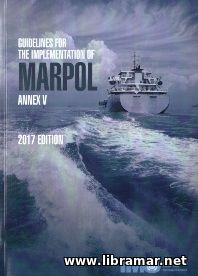
 The officially released guidelines to be used for the implementation of the requirements contained in the Annex V to the MARPOL convention. The documents has several objectives, and the main objective is to assist the states in developing the domestic laws and regulations implementing Annex V and enacting them; it will also provide required assistance to the ship owners and operators, crew members and manufacturers of the equipment willing to reach compliance with the requirements that have been set forth in subject Annex.
In addition, the volume will help port/terminal operators providing reception facilities for the garbage commonly generated on board vessels. The content of the guidebook is arranged in several parts. The guidelines for implementation of the Annex itself is the first part while the second part provides instructions for the development of shipboard garbage management plans.
The next part contains the regulations for garbage pollution prevention including definitions and applications, general prohibitions, information about special areas, special requirements applicable to the fixes/floating offshore installations, exceptions, PSC on operational requirements, placards, record keeping etc. In short, everything related to the prevention of marine pollution by shipboard garbage is covered.
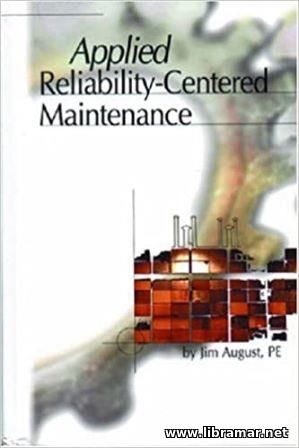 Written by the professional engineer having decades of practical experience, the present volume is intended to be used by the people dealing with the RCM, standing for the reliability-centered maintenance model. The subject model was developed and first introduced by the United Stated Department of Defense.
The original idea was to apply the subject system for controlling the maintenance expenses during the project of the famous 747 air liner, when the idea was to improve the reliability of the craft. In the pages of this volume, the RCM model is being explained in detail to the industry engineers and maintenance technicians and managers in a purely practical way, thus eliminating the boring and too academically technical tone used in the traditional volumes.
As a result of his efforts, the author managed to offer his readers a perfect, concise and understandable guide on what exactly they shall to if they want to achieve the desired results. The volume starts with a general overview of the RC, followed with the maintenance aspects and RCM performance.
After that, the author proceeds to the applications of the RCM, supplementing the theoretical part with the real life examples, talking about all pros and cons. The maintenance software is covered in the separate chapter. Note that there is also a glossary of the terminology used for those who are relatively new to this subject.
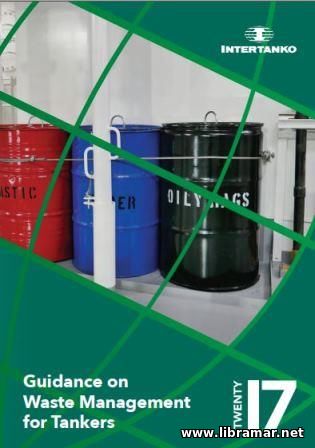 This is a good and practical handbook released by one of the most respected international entities. As the title implies, the idea of the authors was to provide the crew members as well as the shore support people of the tanker vessels with the necessary knowledge of how the wastes, commonly generated on board tanker vessels, shall be conducted without violating any applicable rule or regulation.
First of all, the readers will be acquainted with the general provisions of the MARPOL Convention and particularly Annex V to it, dealing with the garbage pollution prevention. This is followed by the practical guidelines covering virtually all that they need to know in order to dispose of the wastes and remaining in compliance. Here they will find the instructions on the proper use of the shipboard incinerator’s, galley and medical wastes, e-wastes, plastics, boiler wastes and so many other stuff.
After that, they will read about the proper record keeping since this is one of the most important factors, with the records subject to the checks by the port state control inspectors and other authorities. Also, there are some useful instructions provided for evaluating the adequacy of the waste reception facilities provided in the ports.
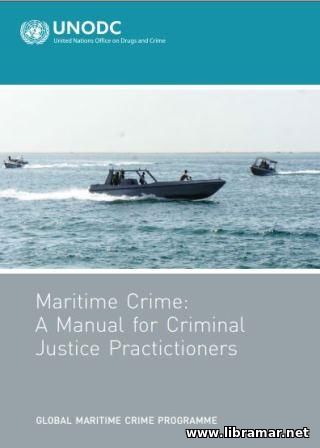 The content of the present guidebook was developed by the United Nations Office on Drugs and Crime within the frames of the GMCP, standing for the Global Maritime Crime Program, with the idea to provide all members of the Organization with the professional technical support required for tackling the whole widest range of the today’s maritime crime.
The necessary support shall be provided by the staff of the Program for fighting against all types of maritime crime including, but not limited to the trafficking of drugs, smuggling, armed robbery, terrorism etc. the idea of the authors of this compact Manual was to collect the available material and present it in a very readable form, allowing readers to use it, setting out the current legal regime governing the different maritime areas.
Moreover, it will give valuable advice on searching activities, collection of the necessary evidence on board ships etc. – the coverage is remarkably impressive. The volume will be ideal for using for training purposes but it will be equally useful when applied as a practical guide for real cases, that is why it is aimed at the practitioners and not only students or graduates of the relevant disciplines.
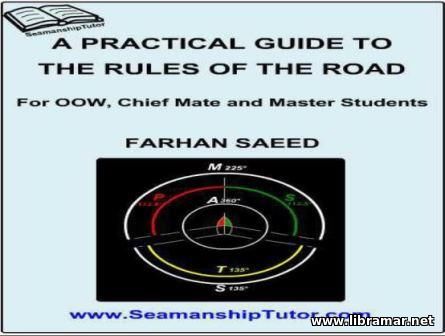 The main objective of the volume was to provide readers with the resource for self-teaching and self-examination on the rules of the road as well as the navigating lights together with the all possible situations. Having gone through all parts of the document with due attention, the readers will be prepared for the exams for COC since the content covers the situations that are normally discussed during the oral exams.
The author presented the material in two parts, starting with the plain and detailed explanation of the Rules, which is followed by the practical situations, and exam questions/answers. The content perfectly covers the Colregs and as such will be really useful for the students.
The text part of the volume is supplemented with the interactive software on the navigating light identification, which is readily available on the website of the author. The deeply worked real life scenarios will not only help you to prepare for the examinations but will contribute to your growing as the specialist ready for working at sea and aware of the provisions of the associated rules, knowing how to behave and what actions to take in all situations that might take place when sailing.
 The Guidance for Ship Operators on PSC contains very valuable information on the ILO MLC Convention which addresses matters of shipping companies obligations related to the contractual arrangements, H&S issues, working hours, crew accommodation, manning agencies, seafarers' welfare and catering standards. There should no any difficulties for the majority of shipping companies to get in due compliance with all the requirements of the convention.
Apart from the brief general overview of the PSC inspection of MLC certification, the booklet contains information on the Maritime Labor Certificate and DMLC. The advice provided in the pages of this small yet quite useful leaflet is mainly intended to provide the operators of the vessels with the assistance in avoiding the potential problems that are usually faced in the course of the PSC inspections. It appeared as a result of close and effective co-operation of ISF and ICS, two organizations that are respected and recognized in the world of shipping.
We would recommend this booklet for familiarization to the crew members as well as the staff of the shipping companies ashore as it directly affects their day-to-day activities and will play considerably significant role in making the work more smooth and effective to both seafarer and company.
 Another official publication developed and released by IACS - this one deals with the single deck container vessels constructed with the double side skin tanks, the passageways and double bottom in the area treated as the cargo space. These vessels are exclusively intended to transport containerized cargoes in their cargo holds as well as on the deck and on top of hatch covers.
The publication starts with the intro, followed by the chapter containing the applicable classification requirements for periodical surveys as well as damage/repair; the next chapter provides some necessary technical background that is to be possessed by the people conducting the surveys; then there is a chapter addressing the survey preparation/planning/execution matters. The book also provides the important information of the failures of the structural parts and instructions on the repairs to be done.
These Guidelines will be very useful for any surveyor performing the above mentioned surveys as well as to any ship owner, or operator, or even any crew member dealing with preparation of the vessel for class inspection and presenting all relevant items to the surveyor. The instructions provided in the book are really the ones to be followed in order to keep the ship safe.
 This guidance was produced by SIGTTO to members' concerns about the some of the interpretations of the functional requirements for emergency shutdown systems; in particular, differences between the needs of the liquid natural gases industry and those of liquid petroleum gases industry. It was also aimed to encourage and promote the use of linked emergency shutdown systems at both LPG and LNG terminals, especially where cargo transfer rates are quite high or where they handle one of the cargoes stated in IGC Code 1993/Chapter 17.
However, this SIGTTO publication is not intended to contradict any international or national requirements or standards for operational practices at the liquefied gas ship-shore interface. One of the primary objectives of this guidance was to advise the operators/owners of gas carriers about the rollover-related issues. The rollover itself mainly refers to the quick release if the LNG vapor occurring when the layers of different densities of LNG are spontaneously mixed in a cargo or storage tank. While for the conventional onshore terminals all such issues are known and understood, for LNG vessels the associated circumstances are a bit unusual and have to be paid serious additional attention...
|