Waste Management on Board
The Ocean is vast, it covers over two thirds of the Earth’s surface and it is home for ninety percent of life on this planet. And, it is critical resource for human life. Regretfully, the Ocean is now polluted by over one hundred million tons of plastic debris.
MARPOL, or the International Convention for the Prevention of Pollution from Ships, contains two Annexes targeted at eliminating waste pollution from ships. These two regulations are important step to protecting the Ocean.
Let us how a look at how MARPOL Annex IV governs the collection and disposal of the sewage at sea, and also check the requirements for storing, sorting and disposal of the garbage, including those related to the shipboard Garbage Management Plan and correct filling of the Garbage Record Book.
MARPOL Annex IV places restrictions on the discharge of sewage from vessels engaged in international voyages. It entered into force back in 2003 and applies to vessels in excess of 400 gross tons., as well as passenger vessels. Sewage includes drainage and waste from toilets, the ship’s hospital, places containing live animals, and any waste water that is mixed with sewage.
The regulations also establish three zones of sewage control. Within three nautical miles off land only sewage from approved sewage treatment plants may be discharged to the sea. Between three and twelve nautical miles from shore, sewage that is fully treated and disinfected, may be discharged, provided the ship is en route. Outside of the twelve-mile limit, sewage may be discharged without treatment.
Annex IV also designated the Baltic Sea as the special area where passenger vessels may not discharge sewage except through an approved sewage treatment plant.
MARPOL Annex V originally took effect in 1998 with subsequent major revision in 2013, to control the collection and discharge of garbage from ships. It also directs that any garbage discharge should occur as far from land as possible. Items allowed for discharge include food waste, bulk cargo residue, wash water and animal carcasses. The Annex bans dumping of plastic waste in any form, including ashes from incinerated plastic. No other refuse may be discharged to the sea.
Food waste may be discharged beyond the twelve-mile limit and, if ground fine to pass the 25mm mesh, may be discharged at three miles. Cargo residues, along with wash water containing cargo residue, may be discharged outside of the 12 NM area provided they do not contain any substances harmful to the environment. Animal carcasses must be discharged as far from land as possible. If food waste cannot be separated from the other garbage, the most stringent discharge requirements apply.
As with Annex IV, this Annex outlines special areas within which additional regulations apply. These special areas include the North Sea, Baltic Sea, Mediterranean Sea, Black Sea, Red Sea, Perian Gulf and Gulf of Oman, the Antarctic below 60 degrees South, and the Caribbean Region, which includes the Gulf of Mexico. Within these areas, food waste may only be discharged within 12 NM of farther from land, and it must be ground to 25 mm or smaller. In Australia, the nearest land 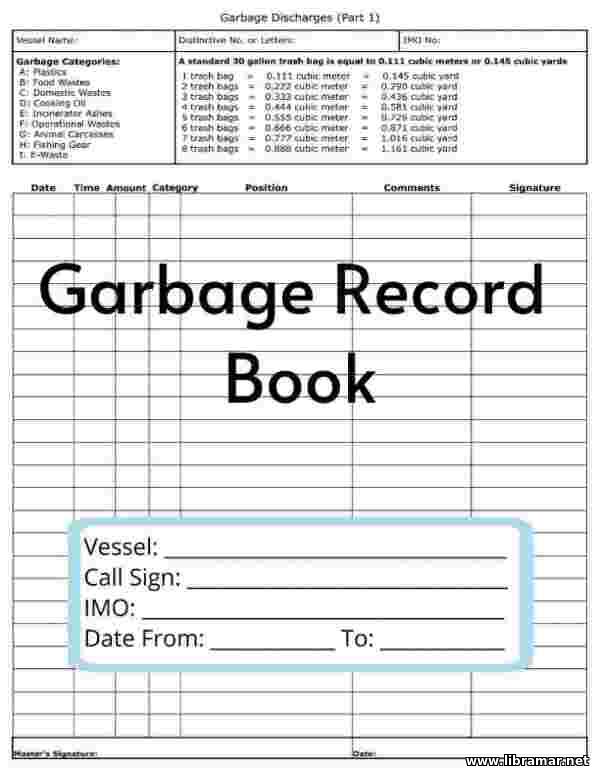 designation begins at the Eastern edge of the Great Barrier Reef, and no discharge may occur there.
Cargo residue may only be discharged in special areas if the cargo residue and cleaning agent do not contain any substance harmful to the environment, both port of departure and port of destination are within the special area, and the ship will not leave the special area between calls, if there are not adequate reception facilities for residue at those ports. In all circumstances, the 12 NM limit must be observed.
The Antarctic Region has additional requirements which includes sterilizing any garbage that contains avian products, including poultry
Passenger vessels and vessels of 100 tons and above are required to carry a Garbage Management Plan, which outlines procedures for minimizing, collecting, storing, processing and disposing of garbage. The Plan also designates a person, or persons in charge of carrying out the Plan.
Additionally, the subject Plan shall list the ship’s particulars and the garbage collection and storage arrangements onboard. A good Garbage Management Plan begins dockside by reducing the access packaging coming aboard with the ship’s stores.
On board ship Annex V requires placards to be posted, informing the crew of the garbage discharge regulations. To best manage garbage, it should be separated by type. The Garbage Management Plan should also include instruction on incineration, and compacting procedures, if there is relevant equipment installed.
Annex V also requires all passenger ships and ships of 400 GT and greater to have a Garbage Record Book. Every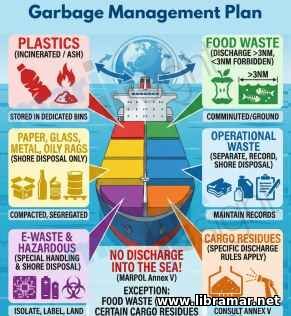 discharge to the sea or reception facility or completed incineration must be recorded properly in there. Additionally, a waste delivery receipt must be obtained from the port facility. If the port reception facility is inadequate to receive waste, or refuses reception, this inadequacy must be reported in the Garbage Record Book alongside the proper ILO forms.
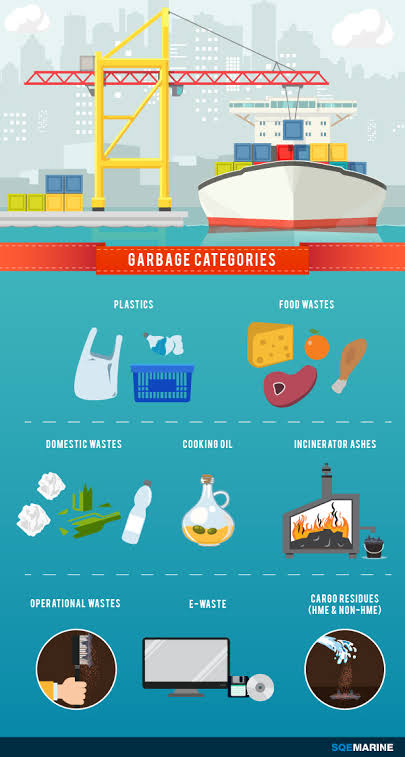
For the purposes of the Garbage Record Book, garbage is to be grouped into categories as follows – plastic, food wastes, domestic wastes, cooking oil, incinerator ashes, operational ashes, cargo residues, animal carcasses, and fishing gear. Each entry must be signed by the Officer in Charge and each completed page of the book must be signed by the Master of the ship.
Entries in the Garbage Record Book must be either in English or French or Spanish. Each entry should include the date, time, position, category of garbage and the estimated amount discharged or incinerated. İn the event of an accidental loss of discharge of garbage an entry should be made in the Garbage Record Book, detailing the location, circumstances, reason for discharge, details of items lost, and the precautions taken to prevent loss.


The "Read Later" function allows you to add material to this block with just one click. Just click on the icon and read the articles that interest you at any convenient time.