Ship Engine Parts and Functions
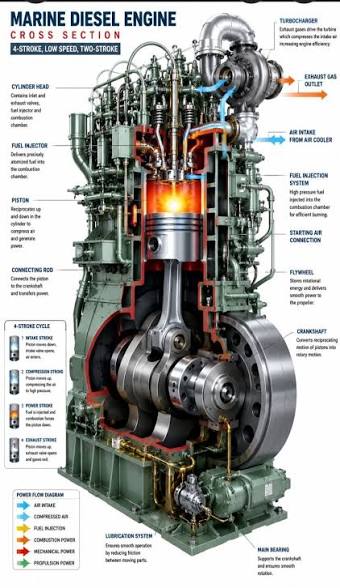
The ship's marine engines are considered to be the biggest engines on earth with massive power to propel a heavy loaded ship. There are different parts of the marine engine which helps the engine to rotate the crankshaft and propel the ship from one port to another. Each component plays an important role in powering and running a marine diesel engine. But the engine cannot run unless all components are in place and are in working condition.
The main engine of a seagoing cargo ships are usually two-stroke internal combustion engines. For a marine engineer or a professional working on ships, it is vital to know different engine parts and their function to operate and troubleshoot when needed. You must have seen the engine inside the machinery room of the ship, covered and assembled with different other auxiliaries.
Let's take it out from its installation and only concentrate on the main engine to understand its different parts. Looking at the exterior of the engine, it comprises of the following parts.
Bed Plate is the foundation block for two-stroke engine. It is built to withstand the constant force from the engine but is also flexible enough to handle constant fluctuations.
A-frame is a fabricated steel structural element of a slow-speed two-stroke diesel engine. It stands on the bed plate above the main bearings. The A-frame carries the cross-head guides and supports the engine entablature, also known as the cylinder block.
An entablature is a part of the ship's main engine which houses the cylinder liner along with the scavenger air space and cooling water spaces.
Turbochargers are heat recovery equipment helping to enhance the efficiency of the engine by supplying fresh air. They are located near the cylinder block.
Charge air cooler is a cooling arrangement for air supplied from the turbocharger before sending it to the combustion chamber. It is usually located below the turbocharger and adjacent to the scavenge space. Scavenge trunk is a space where the cooled air from the charge air cooler is supplied for efficient combustion.
Cylinder head acts as a lid of the combustion chamber and supports the exhaust valve and fuel injectors necessary for operation.
The exhaust valve helps to draw out the exhaust gases post the combustion process.
The exhaust drawn out of the exhaust valve is then transferred to the exhaust trunk from where it strikes the turbine blades of the turbocharger for heat recovery. It is located in between the cylinder head and turbocharger unit.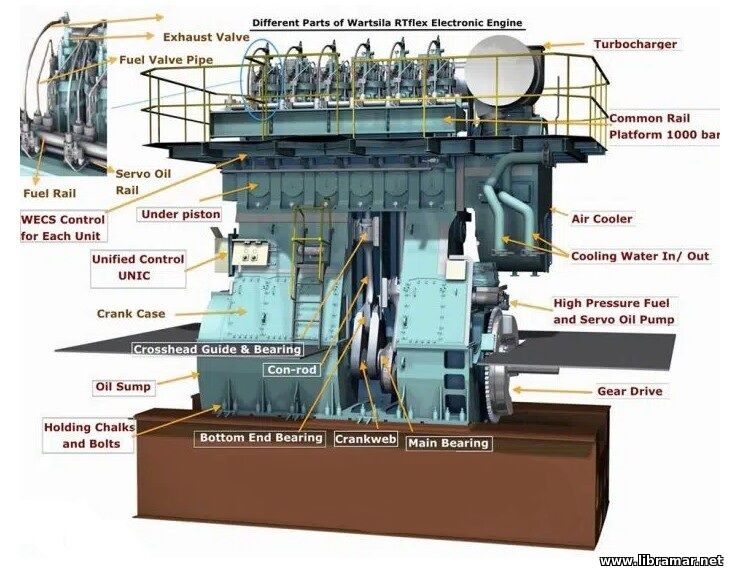
So these are the basic components which can be seen from outside of the engine. Now let's dive inside the engine to understand different rotating and moving parts that are involved in the propulsion process i.e. movement of the propeller.
Liner provides a durable and heat-resistant combustion chamber, preventing combustion products from escaping into the engine itself. It is located at the top side of the entablature.
Piston is used to convert the force of expanding gases into mechanical energy during the process of combustion. It moves inside the liner and is connected to the cross head by piston rod. Piston Rings It seals the piston therefore sealing the combustion chamber preventing gases from leaking into the piston and surrounding areas.
Piston Rod carries the piston and connects it to the crosshead where the motion transfer takes place.
The crankcase is separated from the cylinder and scavenge space by a diaphragm plate on a two-stroke crosshead engine. The piston rod passes through a stuffing box which is bolted into this diaphragm plate. The stuffing box contains a series of scraper rings and sealing rings to seal and separate these two spaces.
Crosshead is a reciprocating block which usually slides in guides and is the connecting point for piston rod and the connecting rod in a low speed two stroke diesel engine.
The connecting rod is fitted between the cross head and the crankshaft. It transmits the firing force and together with the crankshaft convert the reciprocating motion to a rotary motion.
Crankshaft is the main component behind transmitting power to the propeller shaft. The crankshafts on the large modern two-stroke marine diesel engine can weigh over 300 tons. They are too big to make as a single unit and so are constructed by joining together individual forging.
The camshaft carries the cams which operates the fuel pumps and exhaust valves. Because these operate once every cycle of the engine, the camshaft on a two-stroke engine rotates at the same speed as the crankshaft.
Camshafts are driven either by gears or chains. In the case of gear drive, a train of gear wheel is fitted which transmits the drive from the crankshaft to the camshaft.


The "Read Later" function allows you to add material to this block with just one click. Just click on the icon and read the articles that interest you at any convenient time.