Boating at Night
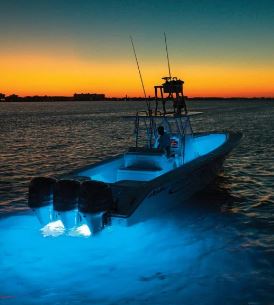
Running your boat at night can be a wonderful experience, or, under other circumstances, can be downright scary. If you're planning a cruise at night, the easiest way to avoid problems is to confine your route to open water offshore. Shipping lanes should be avoided. Inshore waters and intercoastal waterways present the most hazards when boating at night.
You may not be able to visually observe unlighted daymarks and buoys. Another problem is that lights ashore can make identifying lights for aids to navigation very difficult. So can lights on other vessels. Also, running aground in shallow water, or running into obstructions, is several times more likely to occur inshore than offshore. On many of our waterways, especially those that are heavily traveled, there are many things that you can hit in the darkness. But just as important, there are many things that can hit you. So the first consideration, of course, is to make sure that you can see well enough, and that others can see you.
Spotlights are always a good item to have aboard, if used properly. If not, they can cause problems for you as well as other boaters. If you're looking ahead into the path of a brightly lit area of water, your side vision will be affected.
Your ability to see in the dark, or night vision, is not very good under these conditions, and you may not be able to spot red or green lights of another boat or a buoy. A spotlight also can temporarily blind other boaters. Unlike the headlights of an automobile, spotlights point in any direction, and traffic can come from any direction. Even if you're using your spotlight to, say, read the numbers on a buoy, using it temporarily affects your night vision. So it's a good idea to have someone who is not operating the boat to use the spotlight for such things.
Some are well-lighted, and some are not. If you haven't done so, check your helm lights out after dark, prior to a scheduled night departure. Most gauges, such as tachometers and fuel gauges, have built-in lights, so make sure they're working. Ideally, you want to be able to see the instruments easily without the lights affecting your forward vision. Too much light at the helm can blind you when you're looking ahead.
Charts needed for your night voyage should be readily accessible but stored in a dry place. A light to see them, whether built-in or handheld, is of course very necessary. If possible, avoid having to hold the flashlight while using the chart, especially if you must run the boat at the same time.
If at all possible, avoid running the boat while you're looking at a chart. If you can get assistance, use it. Looking at a brightly lit chart and then looking ahead into the darkness can be dangerous. It takes time for your eyes to adjust to the change. It's just not a good idea to read a chart and run a boat at the same time. But if you must, slow down and continue to look ahead, especially if you're in close quarters or traffic.
The lights you use to read charts should be red-filtered. This will help you keep your night vision. Other lights on board, such as deck lights, may be useful in moving about the boat, but they should never interfere with a skipper's night vision or be confusing to another vessel when observing the navigational lights.
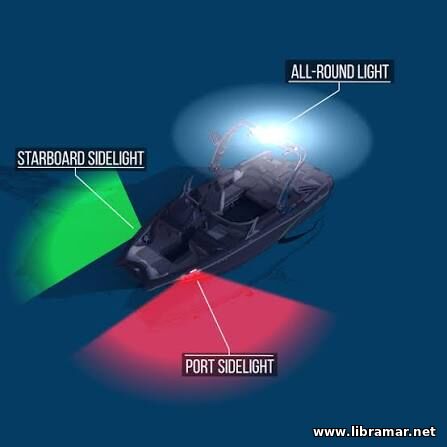
Before departing on a night cruise, there's a lot of preparation to be done. In addition to the normal checklist of items for any cruise, night conditions require other special considerations. Navigation lights, running lights, anchor lights, and special purpose lights, they should all be tested. They tell other people something about your boat, whether you're running under power or in a rowboat or sailboat. They also indicate you're anchored if you choose to do so. Remember, technically, you are underway if not anchored or tied up on the shore somehow.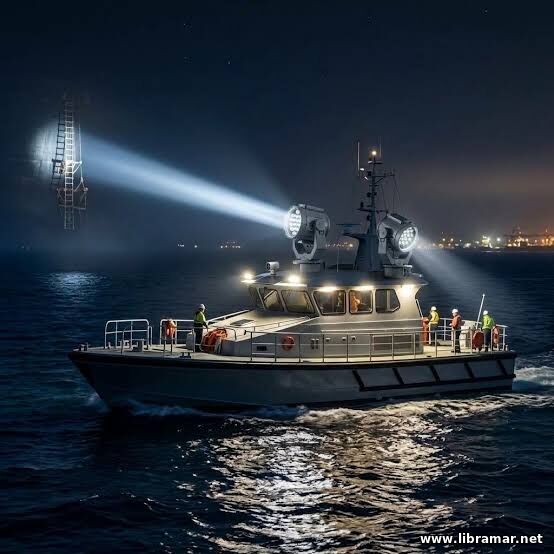
Navigation lights on your boat also tell others in what direction you're headed in relationship to their position. And, since sound signals also play an important role in boating at night, it's a good idea to check your boat's horn. A backup horn or sound signal device would be advisable. The need to sound a warning signal may be more prevalent at night than during daytime operations.
There is only one category of distress signals approved for both day and night use, and that is flares. Make sure there are a minimum of three available that are not beyond the expiration date. Quick-flashing strobe lights of a white color or an electric distress signal lantern may also be used at night. Spare light bulbs and fuses should always be on board and easily accessible. You never know when a light is going out. Don't overlook the tools you need to change a bulb or a fuse.
A waterproof flashlight should be stored with the spare parts and tools in the event you must change things out in the dark. Something often overlooked when using electronic equipment at night is adjusting the brilliance for optimum viewing. Most color video displays, radar units, chart plotters, and depth finders allow you to adjust the brightness of their displays.
Because they're easily seen in the darkness, if the level of brilliance of the displays are too bright, they tend to blind the viewer. So the normal procedure is to reduce the brilliance from that required for daytime operations. At nighttime it's a lot better if it's not so bright on your eyes. Most liquid crystal displays have a backlight that makes it possible to use equipment at night. There may be more than one level of backlight available which could be adjusted for different levels of visibility.
Quite often, GPS and Loran navigators have liquid crystal displays. If they're not in a brightly lit area, backlighting would be necessary. Some marine electronic equipment has soft keys that may be backlit, making it easy for the user to see when adjusting the equipment. One should also study his operator's manual and learn how these adjustments in backlighting or screen brilliance may be performed prior to departure.
It's an LED screen and it takes a lot brighter light, so you need to know how to adjust your equipment at nighttime. So before you set out, you need to know all your owner's manuals and everything and check everything before you go. The difference between boating during the day and boating at night is the difference between daylight and nighttime, right? Well, not necessarily.
All night is not created equal. There's that pitch black of night, and there's also the scarlet night and the moonlit night, and each one has to be handled differently. Different sky conditions greatly affect how well you can see at night. On the water, there's usually not much light, if any cast from anything other than your own boat's lights. Now, whether or not the sky is covered with dark clouds as opposed to clear drastically affects how much light is available to see by. The various stages of the moon, if it's not covered by clouds, also greatly affects how well you can see.
On clear, full, moonlit nights, you may feel as if you can see everything for miles, but on a dark, cloudy, moonless night, the offshore waters are pitch black. Unlike the highways, the waters are not lit by other lights, such as street lights and other car lights, and all the traffic is not confined to a single lane like that of a highway. It's much worse than it is driving down the road because you simply can't see as well.
Bad weather can make boating at night very dangerous. You shouldn't be caught by surprise. If the weather is expected to change or get worse, you should carefully consider delaying or canceling the night cruise.
Fog can also pose a real hazard, and so can thunderstorms. Running a boat at night in heavy seas is usually more difficult than it is during the day, and the deck of a boat tossing about in the dark is not a good place to be.
Large-scale charts simply don't offer the detail you need to identify aids to navigation along your route. Each lighted navigation aid should be marked, and the particular light characteristics should be noted.
All of the various types of lighted aids to navigation, including buoys, day markers, range markers, and lighthouses are covered. On the chart, each lighted aid to navigation is identified as to its light characteristics or period.
Once you have marked each lighted aid along your intended course and become familiar with its light characteristics, you'll be able to identify them as you proceed along your route. You're not advanced of what to expect, and always double-check your position in the event an aid to navigation is not where it's supposed to be. Anyone operating a boat at night should be familiar with the various types of sound signals that may exist on certain aids to navigation. Horns, bells, gongs, and whistles are used to alert you of their position.
Prior to departing, you should always check the charts for hazards that may exist along the way, because if you reduce visibility, this becomes of utmost importance. Shallow water areas, such as sandbars, should be marked on the chart to help you quickly and easily identify each area while you're en route. All of the normal piloting procedures used for daytime cruising should, of course, also be done.
 Taking shortcuts on the proven piloting methods and procedures can cause a lot of problems and even disastrous results at night. For instance, during the day you can see the jetties. At night, you may not. Again, safety should be your number one priority when boating at night. Being able to understand the light and sound signals of other vessels is of prime importance. The big boats and commercial guys use a lot of different light patterns to identify various situations that could be of utmost importance to you.
If you're cruising offshore, you should even be familiar with the light patterns of ships. Now, whether or not a boat is at anchor or towing another vessel or otherwise restricted in her ability to maneuver, should always be of concern to anyone boating at night. Navigation rules, called rules of the road, cover this in more detail, but take some time and effort for an unfamiliar person to learn.
When you have shore background light, especially those in crowded harbors or intercoastal waterways, identifying lights on aids to navigation can be difficult. Even though the light patterns of the aids are designed to prevent this, it isn't always effective. The key is being able to match what is shown on the chart and what appears on the water at night.
Again, knowing your position is of utmost importance. Relying solely on your GPS or low-range receiver or other electronic charts could be a big mistake. Basic piloting procedures should back up your electronic information, even your interpretation of your radar display.
If background lights are creating problems in identifying lighted aids to navigation, slow down. Carefully check your position in relationship to the position of the lighted aid. Comparing what is on the chart to what appears to be a particular aid is the only way you can assume that you're on the right course.
Now, radar can really help. If there is no indication on your radar display, it's very unlikely that what appears to be a lighted aid actually exists. If used and interpreted properly, radar can be of great assistance, especially in narrow channels and crowded harbors and other close quarters. Just remember that it must be set correctly for the conditions, and the gain must be adjusted properly for the particular scale being used. If alarms on the radar are used, and it's a good idea to do so, they too must be set properly.
Otherwise, users might rely on the alarm to warn you of an approaching boat, buoy, or other potentially dangerous targets, when in fact it won't. Knowing how to use your radar is of utmost importance. Remember, things like sea clutter, rain spirals, blind sectors, and other such things can alter the display.
On the other hand, if used and interpreted correctly, the radar can be the single most valuable aid you can have at night. You can even use it for navigation. Again, if and only you know how, and don't solely rely on it.
One good way to learn to use your radar is to use it during the day in close quarters, and compare what you see on the close ranges to what's really there. The more you do this, the more you'll be able to interpret the display at night. Following a channel at night can be a great experience if it's done safely.
If you get off course during the day, near shore or inshore, you'll usually be able to determine it by landmarks near you. At night, you just might be aground before you correct your course. So staying on course is the key.
Following a channel at night is a matter of plotting your course line and determining the distances before departing. Using basic piloting procedures, you should use your compass to take bearings as you travel from buoy to buoy. If you know your speed, and it should be slow, you can determine how long it's going to take to get from buoy to buoy.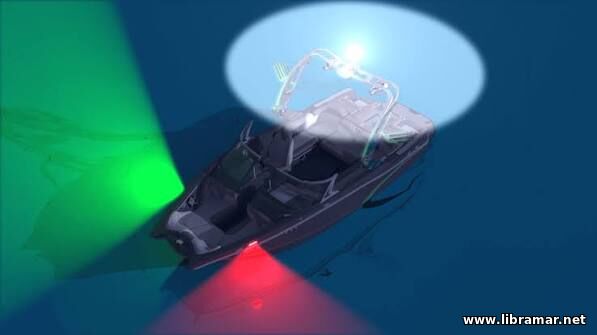
You'll know when to start looking for the next buoy, and when you arrive, check out the number of the buoy to make sure you're where you think you are. Night scopes, even binoculars, can help you identify buoys that are unlighted. Radar can help you spot them well in advance, but basic piloting procedures should still be used.
Always keep a constant check on your depth finder. If you do get off course, this may prevent you from running aground. If you start getting into water shallower than the channel, slow down or stop and correct your course. There's a lot of difference at night coming in this pass and coming through this shipping channel, Joe. In the daytime, you see a lot of shallow water. Out here at night, you don't see any shallow water.
If the red and green lights aren't set side by side or directly across the channel from one another, and often they're not, it can be confusing looking at all the lights. A compass course should set you off in the right direction. It's always been important for skippers to be able to see in low visibility, but in recent years, there's been a lot of advancements in this area.
Let's take a look at some of these advancements and see what they can do, not only to help you see at night, but to be seen. Now, how many times have you said to yourself, can you really see in the dark with modern day-night vision equipment? Well, the answer is yes, you can, depending upon the particular equipment being used and upon the lighting conditions available. Night scopes display monochromatic green images, which do not differentiate color.
Day marks, buoys, and other boats can be identified by their shapes fairly easily, and night scopes definitely prove an advantage. Contrast values are reversed by the night scope, and this takes a little getting used to. Generally speaking, dangers which might be hidden become obvious with a night scope.
There are many different models of night scopes, and they provide various features that may be helpful. Changes in lighting conditions are automatically adjusted to. This prevents you from being blinded if you suddenly view a brightly lit object or area.
Dark overcast nights are more difficult to handle than moonlit nights. A good night scope can definitely add to the margin of safety when boating at night. One good use is to help you interpret your radar display.
If an object appears on your radar screen that you're not sure of, it's a good idea to view it through the night scope. In most cases, it'll take the guesswork out of interpreting radar displays. Certainly they can help identify unlighted day beacons and buoys.
And many objects that will not appear on your radar can be spotted with a good night scope, such as lobster pots, for example. They definitely help you see in the dark, and with a little experience, will make your boarding at night more enjoyable as well as safer. Now, night scopes aren't cheap, but for night cruises, it just might be the wisest investment a boater could make.
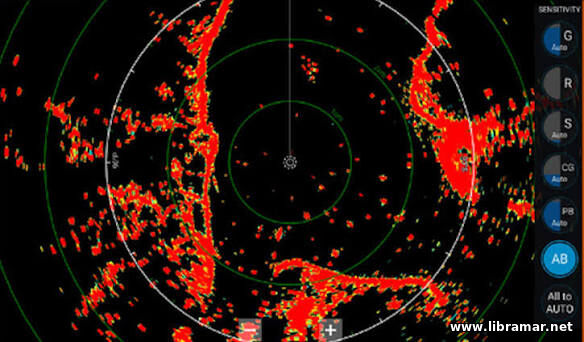 You know, radar has been around for many years, but technological advances have improved their usefulness, especially for the small boater. For example, this Raytheon XX model has three modes of operation, normal relative mode, north up mode, and course up mode. By using the north up mode, you can easily compare what's shown on a chart with what's displayed on the radar screen.
The radar can be interfaced with a LORAN, or GPS receiver, which tells it your position, and an electronic compass, which tells it which direction you're headed. By placing a cursor on a moving target, through what Raytheon calls our mini automatic radar plotting aid, you can determine the target's direction and speed. The radar will draw a vector from the moving target and automatically set up a system of warnings.
Depending upon the chance of collision, the radar will visually and audibly warn you that the target is potentially dangerous, or that it is dangerous, or even very dangerous. Electronic charts also have help to nighttime navigation.


The "Read Later" function allows you to add material to this block with just one click. Just click on the icon and read the articles that interest you at any convenient time.