 The book provides readers with a good insight into the fundamental processes that regulate the marine carbon cycle. The content of the volume is offering a required background in chemical oceanography; in addition to that, it provides readers with the clear description of the way chemical elements contained in sea water and sediments are actually used as tracers of various processes occurring in the oceans - and these processes are biological, geological, physical and chemical.
The chapters of the book are covering the basics of thermodynamics, carbonate chemistry, they provide the explanation of the influence of life on the chemistry of the ocean and how exactly it evolved in the past. There are some topics in the book that contain essential information for understanding the idea of the carbon cycle, including such important aspects as exchange of gas within the air-sea system, organic geo-chemistry, reaction kinetics, diffusion, and so many of other relevant matters. The title will be really ideal to serve as a textbook for all students in geo-chemistry, oceanography, marine science, environmental science and any other fields. It will also be useful for the professionals and scientists in the field and actually to any persons involved in the relevant researches.
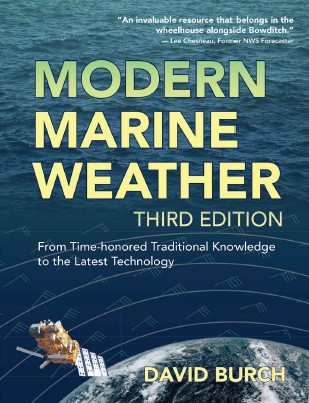 Marine weather information has undergone a revolution in the last five years, prompting a major update to this book. The addition of color offers significant usability improvements. We've expanded the use of GRIB forecasts, incorporating them into maps and images. High-resolution models now make local wind forecasts available in digital form.
Which is most useful to day sailing trips in oceans and locals. This book introduces best practices in weather routing and goes into detail on ASCAT scatterometer winds (now available in GRIB format). We emphasize getting marine weather from email, providing vital process details.
Today's cellphone barometers enhance the value of careful pressure analysis which allows for careful and accurate information. Forecast management (map sequencing) has been enhanced, and squall forecasting methods have been updated. The entire book has been revised for optimal use, although external links may change, you can find any updates at the following link: starpath.com/wx .
 The 21st Century Maritime Silk Road, proposed by Chinese President Xi Jinping, has attracted increasing attention from a broad array of countries and regions. This initiative reflects China’s enduring commitment to peace and development and is posited to promote economic prosperity and regional economic cooperation, enhance intercultural communication, and contribute to global peace and development.
The Maritime Silk Road is expected to inaugurate a new era of global interconnection, cooperative engagement, and mutually beneficial outcomes, underpinned by equality and mutual aid. More than 70% of the Earth’s surface is covered by the oceans, which function not only as regulators of the natural environment but also as pivotal engines of social and economic development. The oceans serve as the cradle of human life and as a repository of resources that may foster China’s national rejuvenation and contribute to the sustainable development of global society. Nevertheless, the initiative entails both challenges and opportunities. The Maritime Silk Road traverses the South China Sea and the northern Indian Ocean, incorporating a large number of states, spanning considerable geographical ranges and long distances.
The complexities arising from the marine environment, limited access to electricity and freshwater resources, diverse political and cultural bases, intricate maritime rights disputes, and persistent geopolitical tensions collectively complicate the construction of the Maritime Silk Road. For instance, storm surges in the Bay of Bengal in 1970 resulted in substantial loss of life. Consequently, a robust understanding of marine environmental characteristics is a prerequisite for the safe and efficient realization of the Maritime Silk Road. However, limited basic research and data scarcity on marine systems presently constrain the full implementation of the initiative and warrant urgent address.
 The present volume compiled by Jan Harff, Peer Hoth and Svante Bjorck, contains the results of a Special Symposium which was held some years ago and dedicated to the Baltic Sea basin with the purpose to foster the due understanding of it looking from the point of structure and genesis as well as processes and utilization issues.
The publication contains the comprehensive overview about the basin of the Baltic Sea, worked out by the scientists in the different relevant disciplines. The volume will be useful not only to the students of all levels but also to the engineers as well as to the people involved in making decisions in the industry and politics.
The authors have summarized the results obtained in the course of the investigations of the Baltic Sea basin and touched the utilization of the resources, thus enhancing the process of the development of new strategies for monitoring and design of technical devices, including various methods of satellite observation, establishing the research lab for international collaboration, etc.
In fact, the material presented in this title will be of interest for representatives of many disciplines, including marine science, marine ecology and biology, oceanography, who are working in the geographical region in question and equally useful to the people working in other areas. It combines the original studies with the review, using the inter-disciplinary approach.
 This volume presented by Edward Carpenter and Douglas Capone is the result of their remarkable efforts in preparing the publication that would provide the industry with a single volume containing virtually all necessary technical info relating to the numerous aspects of the nitrogen cycle.
This publication is intended to present the results of the very latest technological advances and relevant researches conducted in the field of the ocean productivity, with particular emphasis being placed on the key role that the microbes play in the transformations of nitrogen, with excursion to the higher levels.
The main content of this volume is arranged in twenty-four chapters, starting with a brief general overview of both distribution and abundance of different nitrogen forms in various estuaries. This part of the publication provides readers with a thorough comparison of the cycling of nitrogen of various ecological systems within marine environment. The chemical distribution has been discussed there in the other chapter together with the methodology.
The book also covers the enzymology of the starting steps of assimilation of the inorganic nitrogen. The closing chapter is mainly focusing on the application and philosophy of modeling treated as one of the investigative research methods in both open-ocean - and coastal environments...
 This valuable and informative plus interesting title presented today was prepared with the sole purpose to define the fundamental engineering principles relating to environmental reaction, for example design of the reactor, being applicable to the developing of the relevant processes that provide any environmental benefit.
Touching the matters of prevention of the pollution impacting the surrounding environment, the main accent was placed by Martin Abraham and Robert Hesketh - on newly presented technologies minimizing the production of various undesirable side products causing pollution; however, they have also considered the matters of application of the reaction engineering to the treatment of wastes commonly produced by other means.
The opening section of this title mainly concentrates on the environment-friendly combustion, with the three articles addressing the existing methods of reduction of the NOx and PAH formation and it also covers several combustion products sensitive to the environment.
The following section of the book includes a good collection of contributions involving the utilization of catalysts to support the reactions. Then, there section comes dedicated to the use of the fluid solvents. Remaining parts of the book contain numerous interesting documents, dealing with some novel reactor designs.
 The present Encyclopedia can definitely be treated as the most comprehensive and authoritative book on the ocean science of all those available today. This brilliant work was written by the recognized experts and features the valuable contributions from the world known scientists working in the field of marine science, and addresses all physical processes driving the oceans of the world together with the relevant disciplines.
In addition to that, the content of the volume also deals with the topics like global programs and ocean technology, as well as the marine policy and regulatory framework. The impact of the environment pollution is covered together with the climate change. The users will benefit from the easily arrange access to hundreds of interesting articles, cross-referenced and supplemented with the numerous photographs.
Each of the articles is devoted to one specific topic and is written in the way allowing undergraduates to follow the explanations. The active researchers and professionals in the field will appreciate the information on the very latest technical advances. The document will also be interesting to the non-professionals and general readership.
 In the present technical handbook on marine handbook the author, Jeremy Green, provides a good and systematic technical overview of the marine archaeology, offering readers a detailed description of this rapidly growing field of marine science. This second edition of the handbook includes wealth of newly added information related to the utilization of the computers together with GPS, newly established methods of data recording and documenting.
The author of the title is treating the underwater archaeology as a completely separate discipline, demonstrating how the professionals, government officials and scientists usually interact and how the today's market for the artefacts creates various opportunities for these professional groups. The text of the publication is perfectly illustrated with numerous informative images; and the approach that has been chosen by the author is very comprehensive. The volume provides readers with a basic information on underwater environments, land structures under the water, and conditions that are created by the sea by the changes in it's level.
This book has been primarily intended to serve as a guide and source of reference info for all people who are working in the field of maritime archaeology. The original concentration on important technical matters is maintained by the author, since this volume is a technical handbook.
|